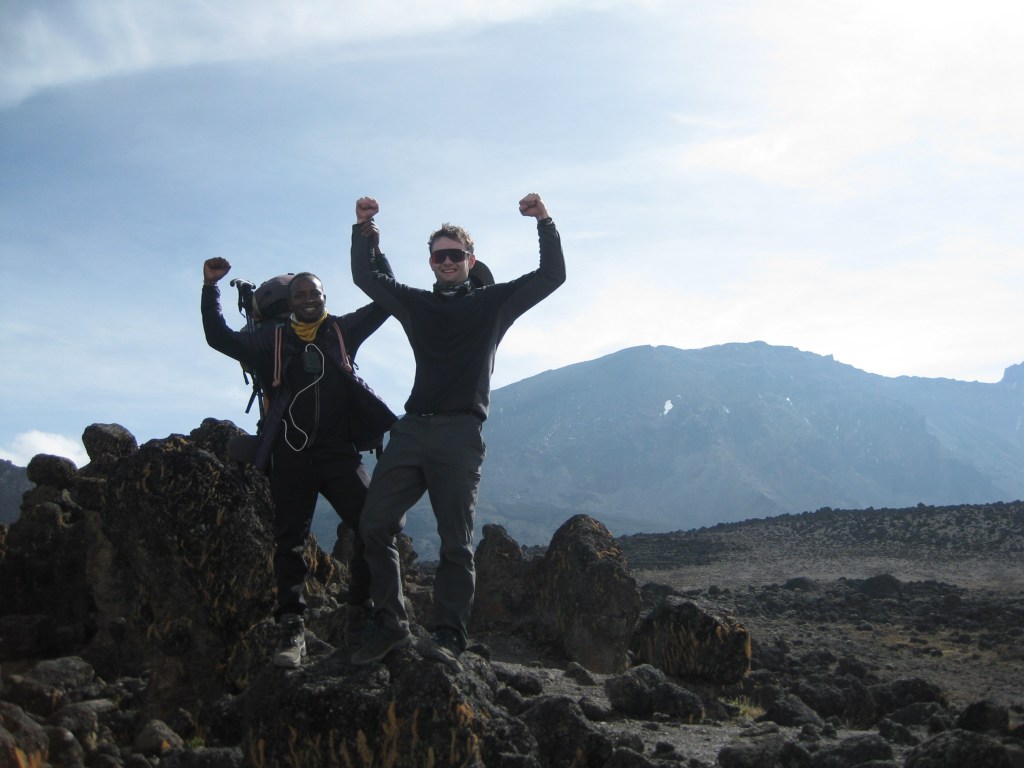
In January 2026, I climbed Mount Kilimanjaro via the Machame Route. I had no previous high-altitude experience, and travelled to Tanzania with little more than a dream, and a pair of hiking boots that were yet to step outside the store.
The following article details my week on Africa’s highest mountain, touching upon its rich history, the people who bring it to life, the inequalities I encountered, and the whirlwind of emotions that accompanied my journey to Uhuru Peak.
Day One (10km): Machame Gate (1800m) – Machame Camp (2835m)
Pole, pole – the Swahili phrase for “slowly, slowly.” Pronounced ‘poh-leh poh-le,’ it embodies a motto for life both on Kilimanjaro and throughout Tanzania. The phrase is a reminder that things will get done only when they are meant to, and one must savour the moment rather than being distracted by self-imposed deadlines. In haste, there is no blessing (Haraka haraka haina baraka), and this measured approach guides the slow, careful ascent that heralds a successful summit of Africa’s highest peak.
At 6:30 am, an alarm rang.
Bleary-eyed, I lay disoriented, confused by the darkness of a room that was not my own. Slowly, my senses returned, and I recalled where I was.
More than 7,000 kilometres from home, I found myself on the vast plains of East Africa, in the shadow of the very mountain that had occupied my dreams for many months.
At long last, my journey to the summit of Mount Kilimanjaro was about to begin.
Walking poles? Check. Headtorch? Check. Thermals? Check. On and on I went like this, scrambling to ensure I had everything I needed before the porters loaded my duffel bag onto the minibus waiting outside the hotel. I had already checked, double-checked, and re-checked my equipment ten times over, but such were my nerves that I felt compelled to run through the list one final time.
At 7:00 am, I stumbled out of the door, finally certain I had everything required for the week ahead. Stepping out of the darkness of my hotel room, I was blinded by the first rays of the African sun shining brightly above, a far cry from the winter cold that undoubtedly awaited my family and friends back home in London.
Squinting against the glare, I peered over the fence to take a closer look at the plains stretching endlessly into the distance. I knew that sixty kilometres to the west, Arusha National Park thrived with buffalos, leopards and even the albino baboons found only in this corner of the world. Another sixty kilometres to the east lay Lake Chala, a deep-blue crater lake on the Kenyan border, fed by the underground springs of the very mountain I was heading towards.
As these thoughts raced through my mind, I knew my inner child was dangerously close to taking over. ‘Focus,’ I told myself. Now was not the time to marvel. There would be plenty of time for that in the days to come.
Turning away, I made my way to the hotel restaurant to greet my eight fellow adventurers. The group included Europeans, Americans, and Asians, as well as two cousins hailing from South Africa. Almost immediately, I found myself wondering exactly what had drawn them from their respective corners of the globe to Africa’s highest peak.
As we introduced ourselves over breakfast, a mixture of apprehension and excitement lingered among us, manifesting itself in a stream of nervous chatter among people who had met only moments ago. Would we stand together at the summit? Who would feel the effects of the altitude? And what surprises would Kilimanjaro greet us with along the way?
Pushing the endless questions to the back of my mind, I wolfed down all the pancakes, eggs, and coffee I could muster. I knew that I would be well fed on the mountain, but having never been above 2,600 metres, I had no idea how my stomach would react to the thin air. I thought it a sensible idea to polish off everything I could whilst I was certain my stomach was still intact.
The moment our plates were clean, our guides quickly carried out one final equipment check, before ushering us onto a bright yellow minibus waiting outside the hotel. On board, I was briefly introduced to five of the porters who would accompany us, the people whose wisdom and experience I would depend on over the coming week. They each had a warm smile, and a voice so gentle I had to strain to hear as they whispered hello.
I was fascinated by the porters and eager to learn more about their lives and experiences. Whilst Kilimanjaro possesses a mystique of its own, it’s the porters who carry its stories, and the truths that are less well-known. I felt that they had much to teach me, and I was determined to learn as much as I could in my time with them.
After bidding farewell to the comfort of the Weruweru River Lodge, we drove off towards the Machame Gate. The road carried us through long stretches of coffee, banana, and maize farms on the dry plains surrounding Moshi, and we wound our way through crowds of people already hard at work in the early hours of the day.
As we came through a village on the lower southern slopes of the mountain, I came face to face for the first time with the inequalities that shape many communities in Tanzania. On one side of the road, children played in the dust outside a row of small wooden huts, yet just across the road stood mansions that looked as if they were fit for a Hollywood film.
Shortly before heading out to East Africa, I’d read that in 2025, the World Bank estimated 48% of the population of Tanzania lived below the international poverty line. What’s more, I’d heard that agriculture accounts for more than half of all employment, despite the sector contributing a comparatively modest share of the country’s economic output. Despite this knowledge, what I hadn’t prepared for, was seeing such profound poverty existing alongside such opulent wealth.
Shortly after passing through the village, the entrance to the Kilimanjaro National Park crept into view. At an elevation of just over 1,800 metres, the Machame Gate was our final stop before beginning the 62km long round trek all the way to the summit and back.
The Machame Gate acts as a security check for those climbing the mountain via the Machame Route. Before entering the national park, our passports and park permits were checked, and our bags were searched for any prohibited items, including alcohol and cigarettes. There is also a small shop tucked in by the gate, where you can stock up on a supply of last-minute snacks for the winding path ahead.
At 10:48 am, once the final pieces of logistics and formalities were complete, we stepped through the gate, and the ascent to Uhuru Peak officially began.
Over the next five hours, we trekked ten kilometres through the rainforest, the first of four distinct ecosystems we’d encounter on the mountain. We moved in single file beneath towering canopy trees arching over the narrow path ahead. In places, the East African camphorwood and yellowwood grew so densely that they completely obscured the blue sky above.
I imagined that, in heavy rainfall or fog, the forest could become deeply unnerving: a perfect setting for a dinosaur to emerge from the undergrowth in Jurassic Park, or for Master Yoda to appear with a quote of ancient wisdom. Fortunately, there were no dinosaurs or aliens to contend with, and my main challenge was the oppressive humidity on the long, steady ascent.
During the walk through the montane rainforest, I found myself in conversation with one of Ahsante Tours’ mountain guides, Bakari. Slender and softly spoken, Bakari had worked on Kilimanjaro for more than twelve years. Unlike many of his fellow guides, he had never worked as a porter, instead completing an accelerated training course that allowed him to qualify directly as a mountain guide.
In fact, his path to guiding tours on Kilimanjaro was anything but ordinary. Before training to become a guide, Bakari had gone to university with dreams of working in the legal system. Despite graduating with a law degree, he was unable to find employment in the field within his country, and found himself scrambling for a means to make a living.
Bakari explained just how difficult it can be to find secure employment in Tanzania, where much of the population relies on informal, irregular work to generate income. Alongside guiding on Kilimanjaro, Bakari also helped found Tanzanite Gems Cultural Tourism, where he introduces tourists to the mining and history of tanzanite, a rare gemstone found exclusively in the Merelani Hills in northern Tanzania.
Whilst Bakari welcomed the income he earned through tourism, he made no attempt to disguise what it takes to mine tanzanite. He spoke of the dangers of the mines, where miners can spend twelve hours at a time digging in dark, narrow tunnels, sometimes more than 400 metres underground.
I got the sense that Bakari saw guiding clients to the summit of Kilimanjaro as less exhausting work than those long days in the darkness of the mines. Judging by the effortless way he glided up the trail, I found that easy to believe.
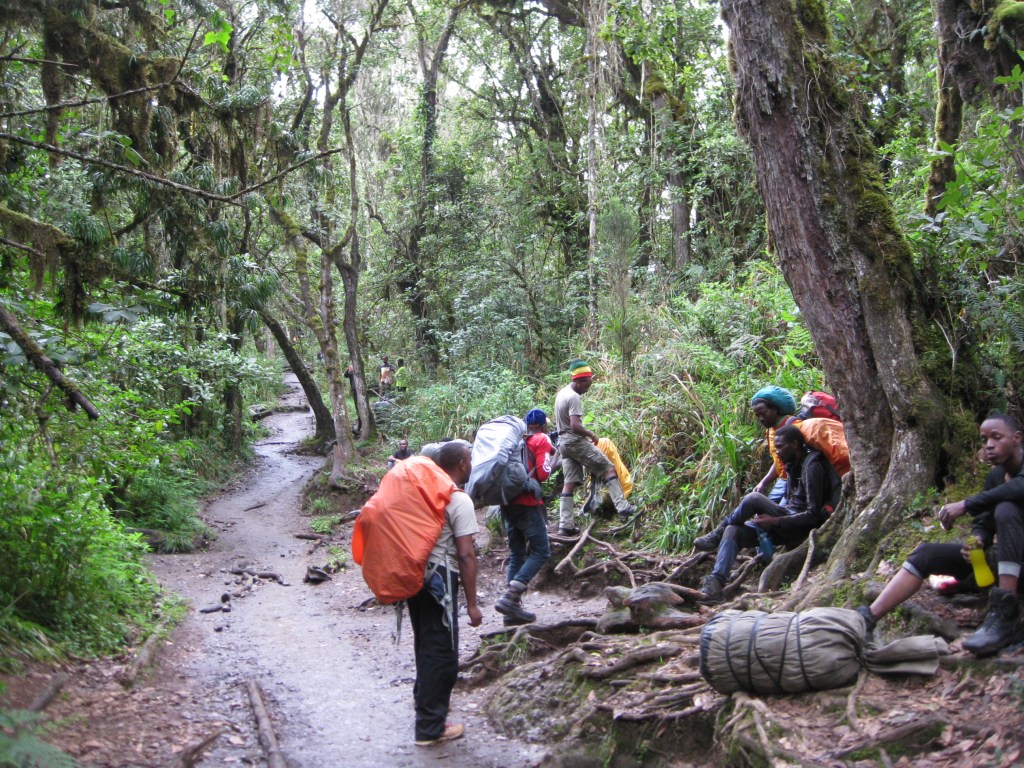
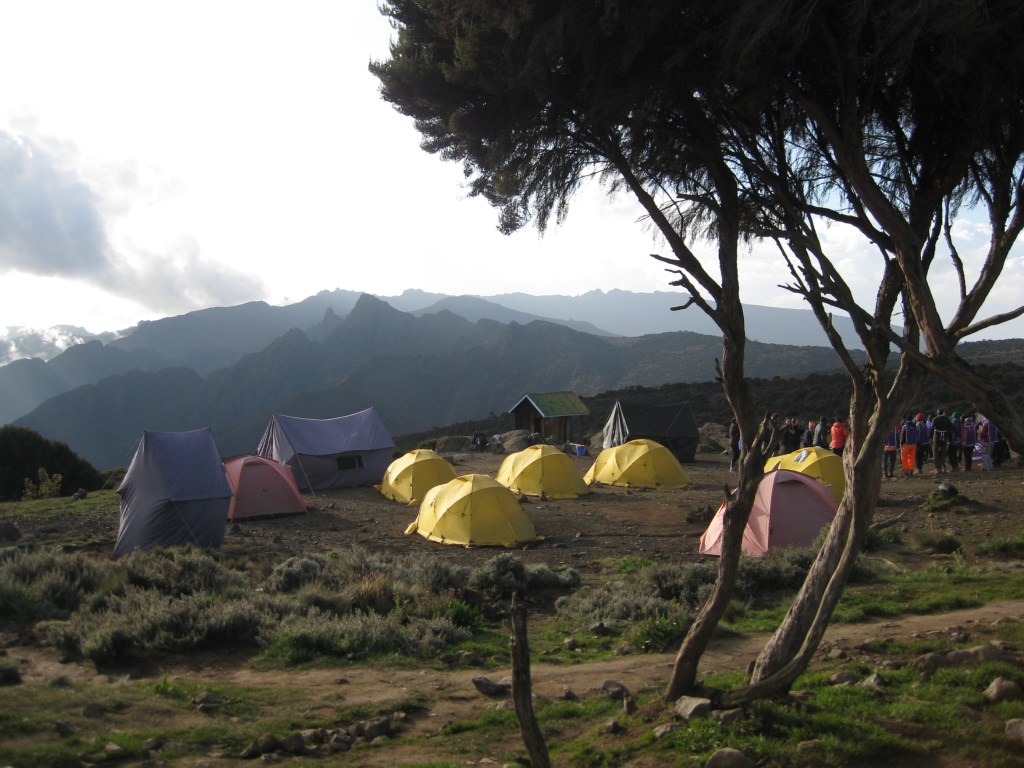
After five hours of hiking, we emerged from the endless greenery to the welcome sight of Machame Camp, our home for the night. Perched just above the treeline, the open mountainside of camp provided a welcome escape from the humidity and claustrophobia of the rainforest.
After registering our names in the rangers’ hut, we were introduced to the team of porters who would support us throughout the journey. Led by our camp manager Michael, the porters greeted us warmly before returning to the demanding task of preparing camp. I assumed it would take some time, but I had barely paused to admire Kibo’s summit in the distance before the tents were pitched, water collected, and the smell of dinner was emanating through camp.
Unlike many hiking holidays in Europe, where hotels and mountain refuges are available along the trails, Kilimanjaro is a camping trip (unless you choose the Marangu Route, which offers small wooden cabins). I had no problem with this, and having camped my way around the Tour du Mont Blanc in the summer of 2025, I knew I enjoyed the simplicity that comes with a week in a tent.
Some of my fellow campers were less enthusiastic about the prospect of a week under the stars. I spared a thought for the two towering South Africans, who were sharing a tent despite each looking as though they could barely fit inside it alone. Fortunately, I was paired with the most eager adventurer in our group, who had recently climbed several of the Alps’ 4,000 metre peaks. He shared my enthusiasm for the outdoors, and after taking a peek inside our bright green tent, we both decided we were more than content with our home for the week.
After settling in, we were called to the communal tent for our first dinner on the mountain. It was here that I first met a man who would play a significant role in my experience on Kilimanjaro. That man was the camp chef, January.
From our very first meeting, I had a soft spot for January. Named after his birthday on 1 January, he came across as shy, an assumption perhaps exaggerated by his imperfect English and softly spoken tone. Alongside two other chefs in the team, January provided meals that transcended what I thought was possible at high altitude. That first night, for example, we enjoyed a banquet of pumpkin soup, chicken stir-fry, salad, rice, and even a warm mug of hot chocolate that sent me to bed full.
As I settled into my sleeping bag, I reflected on how smoothly my first day on the mountain had gone. The only concern was a lingering cold I had brought with me from the UK, leaving one of my nostrils blocked at all times. Of all the weeks to be struggling to breathe, this was hardly the ideal scenario. Overall, however, my first day on Kilimanjaro had offered plenty of reasons to feel optimistic about reaching the summit.
Day Two (7 km): Machame Camp (2,835 metres) – Shira Cave Camp (3,800 metres)
Ngoma – a Swahili word for ‘drum,’ and refers more broadly to dance, music, and celebration. On Kilimanjaro and throughout Tanzania, song and dance serve as vital instruments for storytelling and education. To the rhythmic beat of a drum, communities pass down their history, identity and even values, to the next generation.
After a comfortable first night in the tent, my alarm sounded at 6 am to mark the beginning of day two. I peered outside the tent to find that much of the mountain was still covered by the shadow of night. That remained the case until two emerald green lights flashed past me, and I looked up to see a pair of malachite sunbirds circling above camp.
Looking around, I noticed the guides already gathered inside the communal tent, dressed in their gear for the hike ahead. The porters were hard at work, bringing warm tea and bowls of hot, soapy water to each tent. As I pressed the warm towel to my face, the smell of cooked vegetables and freshly brewed coffee filled my nostrils, signalling that breakfast was on its way.
I started making my way to the communal tent, but stopped to turn and look at the summit that had crept into view behind us. As the fading moonlight gave way to the rising sun, rays of light bounced off the sheet of snow glistening on Uhuru Peak. The collision of light saw the sky surrounding the summit erupt into a beautiful shade of purple, like the tanzanite gem found in the mines nearby.
After a breakfast of porridge, pancakes, and cooked vegetables, we set off for our second day on the trail. Whilst we had ascended more than 1,000 metres on the first day, the route had followed a consistent, manageable gradient. It soon became clear that the gentle introduction was now over.
Within 400 metres of leaving Machame Camp, the terrain tilted abruptly upwards. A long train of climbers zig-zagged up the mountain trail above me, with each turning left and then right every few metres to soften the steep incline. I quickly exerted more energy than at any point on the first day, even before we had passed the 3,000 metre mark where many climbers begin to suffer the initial effects of altitude.
We twisted our way up the mountain pass for the next two hours, stopping only to admire the changing scenery around us. One of the most rewarding elements of Kilimanjaro is transitioning with the mountain as the ecosystems change, and early on day two we traded the rainforest for heath and moorland. Here, the towering trees and tangled undergrowth of the rainforest fell away, replaced by erica shrubs and giant groundsels. With every kilometre, the vegetation became shorter and thicker, battered into shape by the falling temperatures and howling winds.
The trail finally flattened out, and I took the opportunity to scramble up a large boulder for a clearer view of the mountain’s lower slopes. The rainforest stretched out beneath me in an unbroken expanse of deep green, ending only where it met the rich blue sky at the horizon. I smiled at the tropical scenery, in the knowledge that it juxtaposed the ice and snow of where I was heading.
I took time to take some pictures, only to be interrupted by the rumble of music approaching quickly. Looking down, I saw a huddle of porters flying past a train of climbers, led by a singing guide in brightly coloured clothes, with a speaker attached to the outside of his bag blasting Toto’s Africa.
I recognised him as one of our guides, and jumped down from the boulder I had been perched upon to say hello. Augustine, as he introduced himself to me, was one of the more extroverted of the porters and guides. He grabbed me by my shoulders, and grinned as he told me I was looking strong. I scoffed, looking over his shoulder as a team of porters raced ahead. If anyone looked strong, it was those powering uphill with an entire campsite on their backs.
When climbing Kilimanjaro, it is common to gawk at the speed and strength of the porters. From camp to camp, they carry the tents, the kitchens, the bags, the toilet, and everything else needed to make the journey as comfortable as possible. For people with such slender frames, they exert a raw strength that far exceeded what their stature suggested.
However, amidst the sheer admiration I felt, I couldn’t help but notice a more unsettling contrast. Every tourist on the mountain, including myself, was kitted out in hiking boots and clothing that, at the bare minimum, were fit for purpose. There were many others who had evidently spent several thousands on clothing ahead of their trip. Although most of the guides had at least adequate clothing and footwear, the same could not be said for the porters, who are typically the ones tasked with the majority of the heavy lifting. I had already spotted several in flip-flops that looked like they had already seen the higher camps on several occasions, and even a pair of bruised Jordans with the soles hanging on by a thread.
In 2024, African Wilder Trekkers reported that the Kilimanjaro Porters Assistance Project (KPAP) recommended a minimum daily wage of US$10 to $12 for the porters, but unfortunately, we are a long way from turning that vision into reality. According to African Adventure Vacations, many local operators still pay their porters as little as $2 a day.
Words like ‘injustice’ and ‘travesty’ fall short in capturing the inequality of these statistics. Every day, it is the porters who carry 20kg (legally) on their heads and shoulders from camp to camp. Every day, there are porters who cram inside tents alongside up to ten of their colleagues. And every day, there are porters who are fuelled by as little as one meal whilst their clients enjoy a banquet.
Yet not once did I see a porter complain.
Unfortunately, my feelings about this inequality did not improve as we reached Shira Cave Camp. After dropping our bags and taking a short break, we strolled to Shira Cave itself. The purpose of the walk was to climb to just below 4,000 metres to aid our acclimatisation, and also to learn more about the mountain’s history.
The ‘cave’ is a large volcanic rock overhang, not the deep cavern its name would suggest, and can be found upon the Shira Plateau, the ancient remains of Kilimanjaro’s oldest volcanic centre. It is believed that volcanic activity at Shira began around 2.5 million years ago, with its last major eruptive phase occurring approximately 1.9 million years ago, shortly before the northern part of the volcano collapsed. This collapse, alongside later lava flows from neighbouring Kibo, eventually created the approximately 6,200 hectare caldera plain known today as the Shira Plateau.
In the early years of climbing Kilimanjaro, porters would use caves like this as a place to sleep at night. The leader of our guides, William, explained that there was a strict hierarchy, where the strongest of the porters would be granted a place to sleep deeper inside the cave, with better protection from the conditions. The weaker and less experienced porters would sleep closer to the entrance, more exposed to Mother Nature’s will.
During the early 1990s, the Kilimanjaro National Park (KINAPA) implemented a strict ban on sleeping inside caves like Shira Cave. However, the ban was not triggered by the sleeping conditions, nor internal roof collapses. According to trekking operator Kilimanjaro Sunrise, it was introduced as a result of porters lighting wood fires inside the caves for cooking and warmth. Sadly, this led to a series of tragic incidents involving severe smoke inhalation and fatal asphyxiation. Ever since the 1991 ban, all porters and climbers have been required to sleep in designated tents or huts.
Although the cave served as a painful example of the hardships porters have endured, I found it fascinating to learn about their history from William. After finishing his explanation, William led us to the top of the cave, where a panoramic view opened out across the Shira Plateau.
Soon after, I strolled back into camp in time for another wonderful lunch served up by January. I was the furthest away from civilisation that I had been in my life to date, yet staring down at my plate I found fried chicken, seasoned fries, and dressed salad in front of me. It was abundantly clear that I would not have to worry about a short supply of food whilst ascending the climb.
Unfortunately, eating the feast was becoming a challenge for other members of my team. At one point during the meal, one climber jumped from their chair, and squeezed their way outside just in time to reproduce their lunch over the dusty ground. Another was struggling with what they described as a “skull-splitting” headache that had plagued them ever since we ascended to the upper echelons of 3,000 metres.
At altitude, the limited oxygen availability can suppress appetite, even as the physical demands of trekking see one burn calories at a rapid rate. Changes in appetite-regulating hormones may also contribute, although the response to the thin air varies between individuals. Digestion can also be affected, as low oxygen levels and strenuous exercise can reduce blood flow to the gut, while hypoxia may alter the movement of food through the digestive system.
These changes can contribute to stomach discomfort, however, a headache, nausea, and vomiting can also indicate the early stages of acute mountain sickness. This perhaps explained why I saw several guides exchange nervous glances as my companion failed to finish their lunch.
The rest of my second day on Kilimanjaro was spent relaxing beneath the sun on the Shira Plateau. Propped up against a giant groundsel, I read Rick Ridgeway’s The Shadow of Kilimanjaro, the story of the legendary Californian adventurer who climbed Kilimanjaro then walked 500 kilometres through Kenya’s Tsavo region. Descending from Uhuru Peak, Ridgeway followed elephant and hippo trails along dry riverbeds, until eventually reaching the Indian Ocean after a month on the trail.
Some seventy kilometres away, in the opposite direction to Ridgeway’s trek, Mount Meru emerged as the afternoon clouds cleared. Standing 4,566 metres tall, Tanzania’s second-highest mountain appeared dark and ominous against the setting sun. Meru is the eighth-highest mountain in Africa, behind the likes of Kilimanjaro, Mount Kenya, and Mount Stanley on the border of the Democratic Republic of Congo and Uganda.
As I read and jotted down my thoughts, Bakari wandered past in search of a phone signal to call his daughters. I quickly found myself deep in conversation with him again. This time, he spoke about the limitations of Tanzania’s education system, particularly for girls, and the financial strain of sending his daughters to a boarding school he could barely afford.
“If girls in Tanzania have no education,” Bakari told me, “they have nothing. No chance.”
Unfortunately, the statistics support his concern. A 2025 report from Tanzania’s National Bureau of Statistics drawing on the 2022 census found that among young women aged 18-19, only 7.4% were enrolled in upper secondary education, while just 4.5% of those aged 20-24 attended university or other related institutions. Giving his daughters a chance to be a part of that 4.5%, and continue their education, was why Bakari was simultaneously a mountain guide, a miner, a safari guide, and a business owner.
Our conversation was interrupted only when William beckoned us over towards a crowd of porters, guides, and climbers who had gathered around the tents.
Standing in the middle of the group, William raised his voice. “We have now spent the last two days together, but tonight we will take the opportunity to greet each other one by one.
“And then my porters and guides have a gift for you.”
Anyone who has watched videos of Kilimanjaro will have come across the traditional Swahili songs, capable of uplifting even the most weary of climbers. More than a song to motivate or entertain, the tradition allows the porters and guides to share the language and music of their local communities. In doing so, they also bring together a team of people who only days earlier had arrived from across the world as strangers.
One by one, the porters introduced themselves before breaking into song and pulling us into the middle of the circle to dance. The most famous of the songs is a Kilimanjaro adaptation of Jambo Bwana, which can be translated into English as:
Hello! Hello sir!
How are you? Very well!
Guests, you are welcome!
Kilimanjaro? No trouble!
Walk slowly, slowly. No trouble!
You’ll get there safe. No trouble!
Drink plenty of water. No trouble!
Kilimanjaro! Kilimanjaro!
Kilimanjaro, such a high mountain.
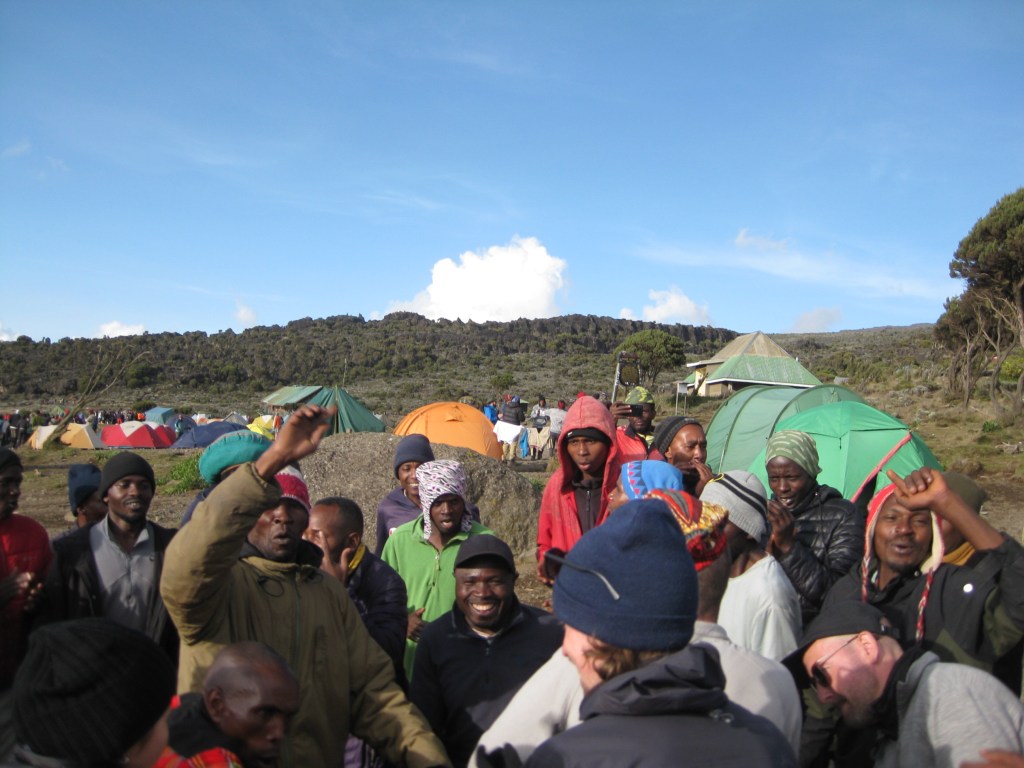
That night, as music and dancing echoed across Shira Cave Camp, the mountain pulsed with a beating heart of its own. Swahili songs, each irresistibly upbeat, rang between the tents and across the open plateau as the daylight faded. Wherever I looked, teams joined in with the same tradition, with porters and climbers sharing the same look of pure, carefree joy across their faces.
To anyone who does not understand the fascination with climbing mountains, moments like this help to explain the ‘why’. Not the adrenaline of the challenge, or the sense of accomplishment that comes with reaching the summit. To me, climbing offers moments of unfiltered beauty shared between people who, on the surface, have so very little in common.
High on the slopes of Kilimanjaro, nationality, language, and cultural difference mattered to none. And in that moment, a small piece of Tanzanian culture had brought every corner of our world together as one.
Day Three (11.5 km): Shira Cave Camp (3,800 metres) – Barranco Camp (3,950 metres)
Orophile – a modern word built from ancient Greek roots used to describe those drawn deeply to the high mountains. The root Óros (ὄρος) means mountain, while Philos (φίλος) means friend or beloved. In the modern world, there are many travellers, tourists, and romantics who feel a profound connection to these peaks.
However, that was not always the case. Historically, Western societies often viewed mountains as frightening and dangerous places. It was only during the Romantic Era, when philosophers and poets like William Wordsworth and Lord Byron began promoting the concept of the “sublime,” that we started to believe something so vast could be a symbol of such supreme beauty, and spiritual peace.
I awoke on day three after a restless night’s sleep. Perhaps the party in camp the night before hadn’t helped, but I felt that the thin air was beginning to show its hand. My cold was lingering far longer than it would have typically at sea level, and I lay there listening as my heart raced to pump blood around my body.
My discomfort did not wane over breakfast, when William warned, “Aside from summit night, today is where most on the Machame Route decide to turn back.” Nervous looks passed around the table, before William followed up with a comment that I believe was meant to reassure us.
“Do not be surprised if you throw up today.”
A second wave of anxious glances flashed across the tent.
By simply looking at the difference between our starting and finishing elevations, you’d scoff at William’s warning. Our evening destination at Barranco Camp was only 150 metres higher than our starting point, and we had covered far greater increases in altitude during the opening two days. Those numbers alone gave very little impression that I’d soon find myself tumbling out of my comfort zone.
But judging the distance and elevation gain alone is misleading, as it fails to consider the acclimatisation hike to Lava Tower, rising 4,600 metres above sea level. Until two days earlier, the highest I had ever climbed to was 2,600 metres in the Italian Alps during the Tour du Mont Blanc.
There was no escaping the fact that day three on Kilimanjaro would be my first taste of truly high altitude. With that being said, I was surprised to feel an absence of apprehension, and instead a sense of anticipation in its place. After all, why else had I made the trip if not to test myself?
I had not travelled 7,000 kilometres across land and sea simply to bask in the glory of a successful summit photo. Nor had I come for the physical challenge alone. In truth, I wanted to see how I would respond when everything familiar was stripped away.
To some, climbing mountains is a practice rich in egotism, suitable only for those in search of something to conquer. There is certainly some truth to that, and I could hardly pretend I had ignored all recognition and praise for what I was attempting.
But when it comes to climbing mountains, something purer exists within that vanity. A purity that I believe lives inside all those who look towards the rugged peaks across the horizon and yearn to climb. The feeling is one that expels sanity and reason, a compulsion that must be followed before it can ever be truly understood.
I longed to feel small and insignificant, just a singular breath in the passing storm. I was searching for a reminder that there is no blueprint to navigate this strange game we know as life, and Kilimanjaro provided me with a perfect opportunity to step away from the comfort I hid behind at home.
And so, as we climbed away from the Shira Plateau, I felt I was ready to relish the challenge of the day ahead. Setting off just behind our leading guides, I watched the moorland vegetation disappear as we entered the alpine desert, the third ecological zone of our trek. If it hadn’t been for the sun shining amber in the early morning sky, the path to the summit would have looked increasingly desolate. Here, plant life is scarce, and the trailside furniture instead takes the shape of loose lava rocks across the barren, volcanic ground.
I’d wrapped up with three layers to begin the day: a thermal base layer, a synthetic fleece, and my outer shell. But despite the elevation and the early start, the heat from the sun glaring down quickly became unbearable. Beads of sweat raced down my forehead, and I stopped to remove two layers and spare my already limited supply of clothes from my stench.
Less than an hour into the day, we climbed above 4,000 metres for the first time. Almost immediately, I began to feel the effects.
Above 4,000 metres, every breath contains approximately 40% fewer oxygen molecules compared to at sea level, and before long I found myself reaching into my pack for paracetamol. An intense headache had announced itself rudely across the centre of my brow, throbbing with such persistence I found it difficult to lift my gaze from my feet plodding slowly along the trail.
With every step forward, my heart pounded in my chest, and my lungs squeezed as they desperately clawed for every drop of oxygen. Just 200 metres below, I had been brimming with confidence. Had that confidence been misplaced? Was it normal to feel such a dramatic difference so suddenly?
I forced myself to look up for a fleeting moment, and I caught sight of Uhuru Peak looming larger than ever above us. I could now make out the contours of the summit itself, and saw where ridges of volcanic rock broke through the latest dusting of snow.
Despite its proximity, it had never felt further away.
I grimaced as another pang flashed across my forehead. “Pole, pole,” I could hear the guides repeating over and over. I laughed nervously to myself. Did they not realise I was already at maximum speed?
It is difficult to describe your first experience at high altitude, even to someone with a history of endurance sport. It cannot be compared to the burning sensation in your lungs after an interval run, nor to the searing pain in your legs when cycling up a twisting Alpine climb.
Altitude is a discipline in itself. It is the judge, it is the jury, and it is the executioner. It tests with little regard for experience or past accomplishments, and punishes its victims with very little warning, if any at all.
The effects vary from person to person, and past performances are not always a reliable prediction for the future. Some people suffer with nausea and stomach problems. Others suffer with the same headache I could feel simmering inside my skull. And while some appear to tolerate altitude better than others, not even the most seasoned mountaineers are immune to its effects.
“It’s my asthma. It’s causing the altitude to affect me more than the others,” I remember thinking. Whenever I caught the eye of another climber, I forced a smile, each a pathetic attempt to mask my crumbling confidence. I could feel my thoughts beginning to spiral, and I knew I needed to arrest the slide before my confidence disappeared altogether.
Whilst I pitied myself, the porters seemed to be enduring little more than a leisurely Sunday stroll. I coughed and spluttered as they roared past me, pausing only for a quick fist bump and a few words of encouragement. Off they went again, with chants of “More water! More fire!” as they ascended quickly out of sight.
Mercifully, after two hours of climbing, the gradient eased momentarily. January had raced ahead to set up a range of refreshments on a gentler section of trail, and he was waiting with steaming mugs of ginger tea and biscuits to help settle the nausea. There were chairs, a table, and bunches of bananas laid out for us. It was as though we had stumbled upon an aid station at a half-marathon, rather than one perched more than 4,000 metres up one of the world’s Seven Summits.
The period of respite lasted no longer than ten minutes, and we continued on our way towards the Lava Tower. Situated on the western side of Kibo, the Lava Tower rests at 4,600 metres, roughly the same height as our base camp for summit night. We would stay there for an hour over lunch, as a means to give our bodies exposure to an altitude we’d need to feel comfortable at 48 hours later.
“Climb high, sleep low,” William grinned to me.
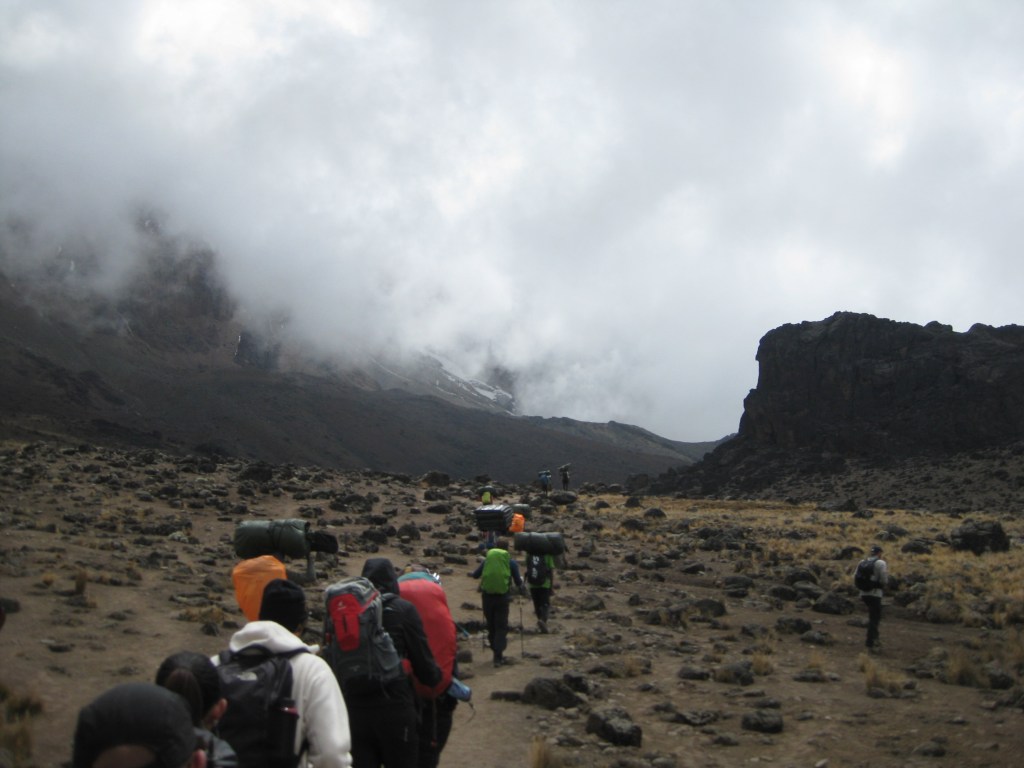
The Lava Tower stands 90 metres tall, formed over 150,000 years ago when molten magma cooled and solidified inside a volcanic vent. Over the millennia since, the softer surrounding rock has eroded away, leaving the tower exposed like a giant fang. Dark and jagged, the Lava Tower points angrily to the sky, a fitting symbol of the inhospitable environment it belongs to.
As the tower crept into view, my headache intensified further, burning a hole directly through the centre of my forehead. I found myself tumbling towards the back of the train of climbers, and a wave of apprehension engulfed me. Were the others handling the altitude better than me?
Staggering my way into the communal tent, I slumped in my chair. I was worried about my condition, but as I peered around the table, I was met by the same grey look I knew was etched across my own face. Shamefully, I felt a sense of comfort knowing that my colleagues were also suffering. It helped to know that I was not alone.
My difficulties were not limited to a headache. I noticed for the first time that my appetite was somewhat subdued, despite the energy I had expended throughout the morning trek. Fortunately, I was still able to eat, and managed several portions of chicken and rice to fuel myself for the second half of the day. The same could not be said for four members of my team, who refused their meal entirely for fear of being sick.
The guides took a client suffering with a headache or a loss of appetite very seriously, but it was not the only variable they monitored. As far as I could tell, their main focus was our blood oxygen.
Throughout the trip, the guides used a fingertip pulse oximeter after every meal to estimate our blood oxygen saturation, known as SpO₂. Readings tend to fall the higher you climb, for example, on the first day mine was 97%, but by the end of day two it had dropped to 85%.
After lunch at Lava Tower, William drew the device from his pocket once more, and one by one, it was passed around the disgruntled climbers. As it neared my turn, I felt my heart beat faster. I was uncertain whether it was due to the altitude, or anxiety at the number I was about to return.
I pressed my finger into the clip and looked away. A number of seconds passed. Finally, William took my index finger out, and read my score: 75%.
I worried that with this reading, I had earned myself the title of ‘one to watch’. But William quickly eased my concerns, reassuring me that whilst it was a significant drop, it was one within his expected range. As the reader was passed around the table, I breathed a sigh of relief as similar scores in the mid-seventies were returned. Although the number alone could not establish how well I was coping, the insecurities that had crept into my thoughts eased ever so slightly.
Yet, just as I had on the ascent towards Lava Tower, I found myself judging my performance based on the assumption that others were handling it better than me. The altitude and anxiety had truly taken hold of me, ridiculing my internal frailties. I was annoyed at myself for unravelling as I had, especially given the confidence I had felt at Shira Cave in the morning.
“You’re already at nearly double the height you’d been to before this trip,” I reminded myself. “This is now well beyond the realms of simply uncharted territory.”
From that moment onwards, I vowed to focus only on my own sensations, and not to let my perception of others cause my confidence to spiral. An insecurity like that would certainly be one the mountain would look to exploit.
Shortly after, we began the descent to Barranco Camp. A dense cloud of fog submerged us, reducing visibility to barely ten metres ahead. I could just make out the mosses and lichens beginning to reappear across the Barranco Valley before a sudden shower swept through. The heat of the morning was soon forgotten, and small streams trickled down the trail, washing away the dirt and dust my boots had accumulated over the first three days.
I was grateful to be heading downhill, but my headache still hadn’t entirely subsided, even by the time we reached camp. I quickly signed my name in the ranger’s hut before heading straight for my tent. Within minutes I was asleep, too exhausted to care that my soaking gear was strewn across my sleeping mat.
Two hours later, the sound of rainfall gently pattering against the roof of the tent woke me from my sleep. I lay inside for quite some time, reflecting on what had been, to say the very least, a turbulent day. I could not help but feel disappointed by how my confidence had unravelled, but I was equally glad to have made it safely above 4,000 metres and back down again.
The question now was whether two days would be enough to acclimatise before climbing over 1,200 metres higher on summit night.
I spent several hours reading in the communal tent, snacking on popcorn, sipping warm tea, and doing anything I could to distract myself from the questions swarming through my mind. I sensed that several others had endured a similar knock to their confidence, as it was a quiet night in camp. We talked, played cards, and ate dinner together, but the carnival atmosphere of the previous evening had vanished altogether.
Then, just as the evening seemed destined to fade quietly away, the porters breathed life back into the camp.
The doors of the communal tent were suddenly thrown open, revealing our head chef carrying a cake. Behind him, the entire team of porters and guides entered singing and dancing, as the cake was passed in our direction.
It was one of my fellow climbers’ birthdays and, without our knowledge, one of the porters had hiked all the way down the mountain and beyond the park gates to collect a cake to celebrate. Within seconds, the tired faces around the table broke into laughter. The doubts of the day were not gone, but for a little while they were silenced.
To this day, I still think about how much I struggled on the climb to Lava Tower, but that night, I did not go to bed troubled. The porters showed that even in the harshest of conditions, and with morale wavering, they were still capable of spreading joy.
Day Four (5 km): Barranco Camp (3,950 metres) – Karanga Camp (4,000 metres)
Haptic – derived from the ancient Greek verb haptein (to touch), and the adjective haptikos (able to come into contact with). In the 20th century, psychologists used the term ‘haptic system’ to define the active combination of touch and bodily awareness that allows us to perceive our environment. For those fascinated by the mountains, and by nature itself, the raw act of touching a rock with their bare hands provides a profound sense of connection that our eyes alone cannot achieve.
After the turmoil of day three, I was pleasantly surprised to rise on day four to find that my headache had mostly cleared. I climbed out of my tent cautiously, almost certain that I was being lulled into a false sense of security. But the expected pang of my headache returning never came, and there was an extra bounce in my step as I made my way to the communal tent for breakfast.
After making the most of January’s pancakes, porridge, and cooked vegetables, I stepped outside and came face to face with the morning’s task: the Barranco Wall.
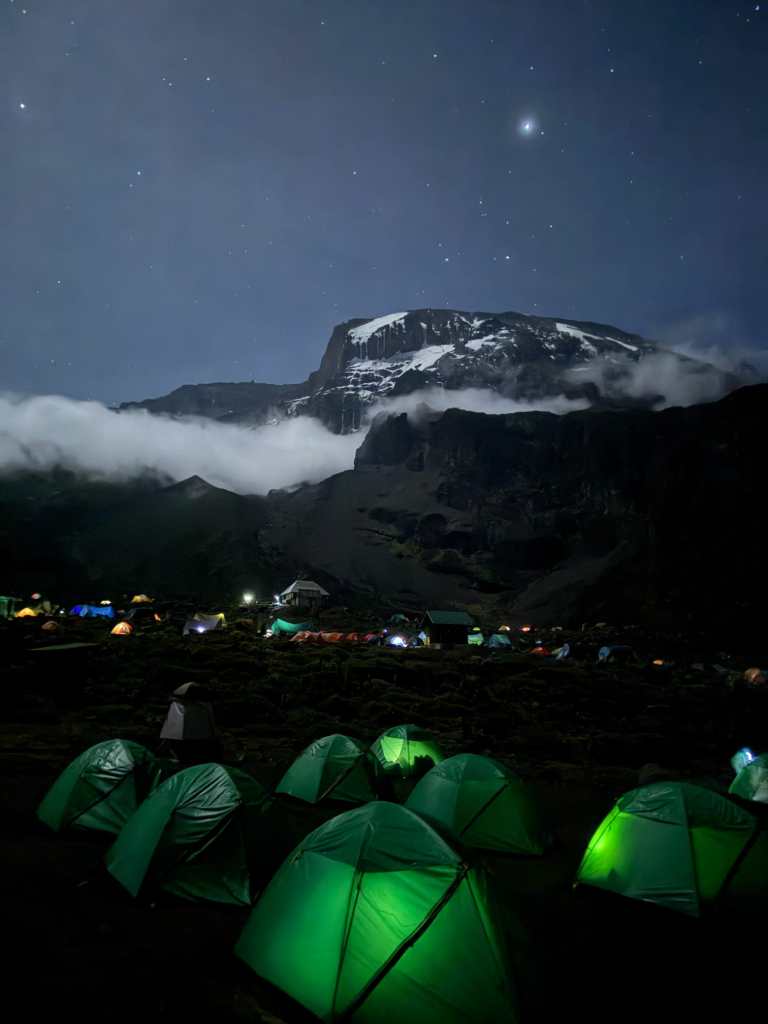
I had barely noticed it the night before, but staring upwards I saw it was monstrously beautiful. Rising 257 metres above camp, the Barranco Wall stood as a dark, ominous barrier between us and the summit in the distance. It possessed gothic qualities: a monolithic cathedral of sharp crags and twisted lava formations. Wisps of cloud gathered eerily along its rugged upper edge, and the last stars of the night sky remained faintly visible, scattered across the darkness like flakes of snow.
Elsewhere, signs of light were beginning to shimmer. Snow streamed from Uhuru Peak like a niveous waterfall, spilling across the dark volcanic rock below. Further down, headtorches flickered on and off inside the tents, casting flashes of green, orange, and yellow across the mountainside. Everywhere I looked, contrasts of light and dark competed for the landscape. I knew in that moment I was staring upon the sublime.
Fortunately, I managed to pull myself from my moment of romanticism and refocus on the task ahead. Much of the advertising for Kilimanjaro plays on the ideology that it is a perfect peak for those without a traditional mountaineering background to experience high altitude for the first time. Whilst it is true that the climb requires no technical skill, the Barranco Wall is a scramble, and thus earns the title of the most technical passage the Machame Route has to offer.
Formed by volcanic activity more than 150,000 years ago, the Barranco Wall requires climbers to attach their poles to their packs, and get their hands dirty on the ancient volcanic breccia. The most famous section of the Wall is known to many as the ‘Kissing Rock.’ Here, climbers place their arms on either side of the boulder, and press their bodies into the wall whilst shuffling sideways across the narrowest section of the climb. Many climbers place a kiss on the rock (hence its name) as they cling on and manoeuvre their way safely around.
Despite the incline and exposure, my confidence was growing. My mind was cast back to my childhood, scrambling up Cadair Idris and Cregennan on an Easter weekend in Snowdonia. Those were the moments that fuelled my connection with the mountains, and the same freedom I felt all those years earlier returned as I scaled the volcanic remains.
I felt confident on the rocks, and certain of my foot placements as I guided myself around the exposed sections. I was moving at a faster pace too, and I had barely noticed that we had passed above 4,000 metres, the point where just twenty-four hours earlier I had started to crumble.
“Maybe these guides know a thing or two about acclimatisation,” I thought to myself with a grin.
When we crested the brow of the wall, we were welcomed by the porters who had set up an aid station with a picturesque view of the summit directly in front of us. The sun was out in full force, and I paused to take some pictures whilst sipping on a warm mug of ginger tea. We were now at 4,233 metres, but those two hours on the Barranco Wall had restored my excitement for what was to come.
Following a short break, we set out towards the next destination, Karanga Camp, two hours to the east. As we ventured back into the alpine desert, the lack of vegetation along the ridge left us exposed to the howling wind. The porters warned that by nightfall the temperature would drop below zero, and we would spend the majority of the next three days bundled in multiple thick layers.
In spite of the imminent cold, the passage to Karanga Camp is actually a section of the climb where regular hydration is paramount. The lack of shade leaves climbers at the mercy of the sun, and the UV index can soar excruciatingly to eleven, twelve and sometimes above. My Irish heritage was being pushed to its absolute limits, as were the capabilities of my sun cream and electrolytes.
There are also very few water sources from this point onwards. In fact, the final opportunity for the porters to collect water comes from the stream in the Karanga Valley, which sits directly below camp. By the time teams reach base camp ahead of their summit push, porters must trek backwards and forwards, up and down the mountain to collect water for camp. That’s a round trip of over 600 metres of vertical ascent, and can take over three hours each time.
Ahead of my trip, I had read plenty of articles detailing the impact of climate change on Kilimanjaro. I had also heard murmurs of porters and climbers alike discussing the lack of snow on Uhuru Peak, but for the most part I had been too focussed on my own health to spare a thought for that of the mountain’s.
It was only during the hike to Karanga Camp that the examples became too difficult to ignore. To my left, jagged gullies were cut deep into the volcanic scree. Augustine told me that blankets of snow used to protect this fragile soil, but the drier conditions had left the terrain bare and vulnerable. He explained that the erosion is worsened by erratic seasonal rainstorms and sudden pulses of glacial meltwater flashing down the unprotected slopes, carving aggressive channels into the mountain’s outer layer.
The further up the mountain you go, the more visible the changes become. According to UNESCO, Kilimanjaro’s glaciers have lost 91% of their surface area since they were first mapped in 1912. Such is the rate of glacier loss that the World Meteorological Organisation has projected that the remaining glaciers could disappear entirely by 2040.
Only days earlier, I’d read in Rick Ridgeway’s book that he had required micro spikes at the summit back in 1996. Thirty years later, there was no suggestion that would be the same for me.
We arrived at Karanga Camp with most of the afternoon still in front of us. Fatigue was high, but a sense of calm washed through camp as most chose to read, journal, and give their bodies a moment to pause and recuperate. My journal entry from the day reads:
“The low croak of white-necked ravens, porters laughing over a game of cards, and the distant trickle of the stream below are all I can hear. Otherwise, a silence I have never experienced before.”
Everyone’s attention had turned to the following day; we were now less than 36 hours away from beginning the summit push. The Barranco Wall had reinforced my confidence, as it had for many of the others, but I was aware that this could be the final opportunity to recharge properly before ascending back into far more uncomfortable territory.
As dusk crept in, the lowering sun cast a desert-like glow upon the rocky terrain. I spent over an hour perched on a large, grey boulder facing away from camp, with a perfect view of the summit in all its splendour. Deep in thought, I noted that there were still roughly 1,900 metres of elevation between me and Uhuru Peak, as had been the case for much of the past two days. We had spent much of the preceding 48 hours hovering between 3,800 metres and 4,600 metres. Of course, this was deliberately so, and aligned with the acclimatisation philosophy of “climb high, sleep low”.
Despite the obviously sensible guidance, I couldn’t help but notice that a hint of impatience had begun to seep in. It felt as if we were now perpetually circling the mountain, rather than taking any substantial chunks out of its armour. Just how long could the summit tease from above?
I sighed, and reminded myself not to rush. The climb is not only about the summit; the summit is merely a reward for patience. I decided to distract myself by jotting down my memories and conversations from the day in my journal, and soon the suggestion of arrogance faded away.
As I sat upon the rock, porters on their way up from the water source below stopped to talk, regardless of whether they were from my team or not. Many simply wanted to say hello; others were keen to hear what I thought of Tanzania and Kilimanjaro so far. When I detailed my experience as “the adventure of my life,” they eagerly told me that I should stay for a safari tour, or join them in climbing the neighbouring Mount Meru. It was a compelling sales pitch, and had I had more than mere pennies to my name, I would have happily obliged.
Before turning in for bed, the clouds dropped their curtains to reveal the twinkling lights of Moshi below. From our aerial view, Moshi conjured the illusion of a vast urban grid, as if it were a sprawling American metropolis like Atlanta or Los Angeles on a midsummer night.
Further in the distance, veins of lightning crackled inside a cloud, and its momentary flashes illuminated the vapour like a puff of purple smoke. As majestic as it was, I retreated to my tent glad that it was in front of us, rather than directly above us. It was already set to be the coldest night; I was relieved it would not be the wettest one too.
Day Five (5 km): Karanga Camp (4,000 metres) – Barafu Camp (4,650 metres)
Bergtagen – a Swedish word associated with the folkloric idea of being “taken into the mountain.” In Scandinavian folklore, humans could be abducted into the rocky kingdoms by a supernatural being like a spirit, a mountain King, or even a troll. These entities enticed their victims through visual illusions, like a rock wall opening to a reveal a golden hall, or enchanting melodies that placed them under a spell. Should some be lucky enough to escape physically, their mind would often remain permanently altered, leaving them detached from society forever.
Just before 6 am, the rustling of porters rising for the day woke me from my sleep. I unzipped the corner of my tent and peered outside, only to find that dawn was yet to break across the southern slope of Kilimanjaro. I heard a murmuring to my right, and I could faintly make out the silhouettes of several guides huddled closely together around the communal tent.
An icy breeze brushed my cheek, and I quickly rolled back inside the tent. I lay there shivering, making the most of every second I had inside my mummy-shaped sleeping bag. But not even its additional insulation was enjoying a great deal of success keeping out the morning chill, and when I turned my headtorch on, I could see each breath as I panted for air.
For a fleeting moment, I wished that I had listened to my mother’s eternal mission to drown me in a swaddling of clothes. “Bring another layer,” I could almost hear her say. She certainly would’ve had a point on this occasion.
Eventually, after an extra 25 minutes cocooned inside my sleeping bag, I crawled reluctantly from the tent. The temperature reader claimed it was ‘only’ -5°C, but the absence of the sun dispelled all sense of warmth, and it would be another hour before the first rays of comfort broke through.
Stretching slowly upwards, the reality that the summit push was less than a day away dawned upon me. Much less, in fact; if everything went according to plan, in twenty-four hours’ time we would have passed Stella Point, and could even be nearing Uhuru Peak itself.
I could feel the emotions bubbling inside me; a dormant volcano that had been edging closer to eruption ever since I booked the adventure three months earlier. Reluctantly, I decided to suppress these feelings for a little while longer. After all, there was still a hike to navigate before I could be certain that I would at the very least attempt the summit.
Our launch pad for the summit push was Barafu Camp, only a 5 km trek from Karanga Camp. The guides estimated it would take anywhere between two and three hours, by far our shortest day on the trail. The distance was deceiving, however, and the altitude all but ensured that those 5 km would be my most pitiful shuffle yet.
Back home, I’d associate 5 km with the parkrun on a rainy Saturday morning in Sheffield. The path winding around the trees of Endcliffe Park was the theatre of many fast, and often ruthlessly hungover, conquests during my time at university. Above 4,000 metres, however, my speed at sea level would evaporate, and only the crippling headache would remain comparable.
At over 4,650 metres, Barafu Camp stands at an altitude that had humbled me during the visit to Lava Tower two days earlier. Could 48 hours really be enough time for my body to adapt? And if I felt the same as I had done then when I arrived, could I possibly hope to rise nearly 1,300 metres higher during the night?
We set off, shuffling along at a new record-breaking slow. William warned that the first hour held the most challenging gradient, and sure enough, the trail tilted upwards immediately after leaving camp.
I had plenty of time to observe my surroundings. If I looked upwards to the left, there was a spectacular view of the colossal ice cliffs and hanging glaciers of Kibo. Directly around me, however, the surroundings were far less spectacular. The colour green had become a figment of the imagination, and I squinted in desperate search of any signs of vegetation. The evergreen conifers and lush canopies of the rainforest were now a distant memory. More and more, I felt as if I had landed on the moon, or a faraway land devoid of any life.
The term ‘alpine desert’ feels paradoxical when applied to a mountain home to a tropical rainforest. However, sitting between 4,000 and 5,000 metres on Kilimanjaro, the alpine desert receives just 250mm of rainfall every year. The thin atmosphere leaves the dry surface exposed to a UV index that can sometimes rise above 15, which plays its part in creating an arid, lifeless landscape.
Additionally, the alpine desert is where many are forced to turn away. In September 2009, on the challenging Western Breach, multiple newspapers reported that former Chelsea owner Roman Abramovich was carried down by a team of porters after suffering breathing difficulties. Some articles suggest that the Russian billionaire failed to complete the recommended acclimatisation period and consequently fell victim to altitude sickness, although Abramovich and Chelsea denied these claims.
Even nine-time Wimbledon singles champion Martina Navratilova had to abandon her attempt in the alpine desert. Back in 2010, the 54-year-old led a team of 27 with a goal of raising $133,000 for the Laureus Sport for Good Foundation, having defeated breast cancer earlier in the same year. But around 4,500 metres, the Czech-American experienced symptoms of high-altitude pulmonary edema (HAPE), and her oxygen saturation reportedly plummeted to just 68%.
Navratilova later told reporters outside the Nairobi Hospital that her diary entry read, “I’ve never been so utterly exhausted. Everything is taking monumental effort, going to the bathroom, getting dressed, setting up tent.”
Yes, Kilimanjaro is a highly popular trek that many novice climbers successfully summit. And yes, many view it as the least demanding of the Seven Summits. But its extreme altitude should never be taken lightly. Once you pass 4,000 metres, any sense of control is merely a mirage, and at that height, the mountain always dictates the terms.
Fortunately, I was feeling stronger than I had expected. Or, at the very least, stronger than I had done at Lava Tower on day three.
My headache had returned, but the searing sensation that had shattered my confidence before had yet to re-emerge. I swallowed a couple of ibuprofen tablets, and continued to trudge along the trail, taking care to sip my electrolyte-enhanced water as regularly as possible.
During one break, I handed out a bag of jelly babies to a group of porters, each of whom thanked me with a warmth disproportionate to a gesture so small. One porter in particular, with high cheekbones and hands clasped casually behind his head, grinned and asked whether he could perhaps have another. I peered over his shoulder, and spotted the bright green duffel bag that he had been carrying. I looked down in embarrassment as I passed him another sweet. That particular bag was mine.
Once more, two juxtaposing feelings tore away inside me. I didn’t know whether to feel shame at the sight of another man labouring under the weight of my own belongings, or relief that he had a source of income in a country where so many do not. I remembered back to my conversation with Bakari on the first day, when he told me that even with a law degree, working on the mountain was one of the surest means he had found to make a living.
Perhaps there is no perfect answer to the moral question that confronts all tourists on Kilimanjaro. At times, I felt as if I was being carried up the mountain on a throne, borne aloft by another’s hard work, and throughout the trip it is impossible to look away from such palpable inequality staring straight at you. Yet, I would argue that to meet that inequality with pity would do nothing more than dehumanise the porters to objects of sympathy. They are the beating heart of the mountain, and to look down upon them would be a transgression to the climb itself.
I continued to mull over this question as we approached the final incline to camp. The tents of Barafu are delicately pitched along a narrow, sloping ridge that emerged into view long before I was able to unlace my boots. By this point, headache was signalling its intent to intensify, and several others were struggling with their stomachs. Unfortunately, the mountain showed no signs of sympathy, and the final 20 minutes into camp saw the trail evolve from a gentle gradient to a steep incline of loose scree and jagged slabs.
In Swahili, ‘barafu’ refers to ‘ice,’ which is fitting for a campsite that can suffer temperatures as low as -15°C at night. Come March, the basalt boulders and protruding rocks mingling between the tents are often blanketed in thick sheets of snow. Whilst I did not have to contend with snow, our intricate positioning along the narrow ridge left us exposed to the weather from both sides.
Of all the campsites on the Machame Route, Barafu is the one positioned most precariously. As the sun heats the lower slopes of the mountain in the early afternoon, warm air rises up the mountain flanks and collides with the freezing air above 4,000 metres. This convergence causes severe atmospheric turbulence in the form of violent gusts of wind, and it was not long before a blast threatened to send me crashing into a nearby tent.
Tragically, the antagonistic setting of Barafu Camp was the scene of a fatal accident just a month before my trip. On Christmas Eve 2025, a rescue helicopter operated by Kili MedAir was executing an emergency evacuation of a climber in distress, when it crashed and burst into flames in the Barafu Valley. All five lives on board the aircraft were lost, including the pilot, a doctor, a mountain guide, and two climbers from the Czech Republic.
Mountaineering history is littered with disasters involving helicopters performing rescues in the most dangerous, uninhabitable places our planet has to offer. Whether it is the upper slopes of Kilimanjaro, the Khumbu Icefall on Everest, or the glaciers of Mont Blanc, the thin air can have a significant, and sometimes catastrophic, impact on the performance of a helicopter’s engine and blades.
I could see no sign of remaining debris, but I sensed nervousness amongst the porters whenever the topic arose. Several of them had been on the mountain when the accident occurred, and one had sprinted to the scene after the helicopter spiralled to the ground. It was no surprise, then, that each time the whir of incoming rotors echoed from above, I spotted porters looking nervously towards the sky.
Shortly after signing in at Barafu’s rangers’ hut, I carefully climbed a cluster of loose rocks to join Augustine overlooking camp. As I sat down, Augustine pointed to the east across the plateau and in the direction of the jagged silhouette of Mawenzi, Kilimanjaro’s second-highest peak.
Unlike Kibo (Kilimanjaro’s main peak), the lesser-known Mawenzi features a more traditionally mountainous appearance. At 5,149 metres, Mawenzi’s serrated towers could easily be mistaken for Aiguille du Dru or Aiguille Noire de Peuterey in the Alps. It truly could not be more different to the enormous, level peak of Kibo.
Augustine noted that such is the technical skill required for scaling Mawenzi, TANAPA only grants access to experienced climbers with a repertoire of technical ascents. Whilst over 30,000 people attempt to climb Kibo every year, there are years when no one reaches the summit of Mawenzi. In fact, for much of the 2000s no one was granted access to it, after a series of fatalities caused by rockfall.
Even before the early 21st century, Mawenzi was the scene of another devastating episode on Kilimanjaro. Looking across the Saddle between Kibo and its sister peak, Augustine spoke of the disaster of 18 May 1955, when an East African Airways flight crashed into the southeast slope of Mawenzi. The aircraft, a Douglas DC-3, was heading to Nairobi from Dar es Salaam when thick cloud cover suddenly submerged the upper slopes. Blinded by the fog, the pilot crashed directly into the serrated rocks of Mawenzi, killing all 20 on board. Such was the enormity of the disaster that the tragedy earned the grim nickname of the “Titanic of Mount Kilimanjaro” in local folklore.
Mercifully, this rather traumatic conversation with Augustine didn’t last forever, and we drifted on to less depressing topics. I found Augustine an intriguing character; he had a blend of traits that made him particularly popular, but his characteristics didn’t always sit easily together.
On the one hand, he was dubbed the strongest climber by his fellow guides, and enjoyed blasting RnB music loudly from a speaker when it was his turn to lead us up the climb. Yet for all his eccentricity, Augustine was also gentle and softly spoken. He had a deep knowledge of the plants and wildlife surrounding us, and took great pride in sharing his wisdom with others.
When the conversation turned to Tanzania’s inequalities and its political landscape, his caring face would harden with a seriousness that reflected his thoughts. He also felt no obligation to hide the living conditions of the porters from his clients, and was frank in telling me any donations of sleeping bags would be very well received.
In many ways, Augustine was the boisterous younger brother of the family of porters and guides. He had talent and strength that stood out in a group full of both, but he wore his raw ability with an extroverted flair that many of the other guides didn’t exuberate.
One night in the tent, William had warned that Augustine could not be trusted with even a drop of alcohol, a comment that was met with both laughs and nods from the other guides in the room. The longer I spoke with him on the toothed boulders above Barafu Camp that afternoon, the more I could picture why!
Eventually, Augustine bade farewell and returned to his duties preparing for the night ahead. I stayed for another five minutes, and allowed myself to breathe in deeply, and acknowledge the reality of what was to come. The obsession that had held my thoughts hostage for weeks and months on end was now within my grasp. The Roof of Africa was within touching distance; all that separated me from its summit was one final push in the endless darkness of the night.
Gazing up towards the intended destination, I was overwhelmed by a breadth of emotions, ranging from fear and apprehension to gratitude and even a dash of confidence. I knew I had the physical ability, but there was no way of telling if I could withstand the torment of altitude during the long night ahead.
I took one last deep breath, before climbing down to begin perhaps the strangest evening of my life.
After an early dinner, William and his team of guides came into the communal tent to deliver a motivational speech. Each of the guides took the time to share words of encouragement, emphasising that they would be there with us every step of the way to the summit.
After passing the final health checks, we were officially cleared to attempt the summit. With the moment of truth now upon us, William walked us through the logistics for the following day.
It quickly became clear that when he said ‘the following day,’ he actually meant later that night. Alarms would be set for 10:30 pm, and following a quick breakfast we would take our first steps to the summit at 11 pm.
I glanced down at my watch. That 10:30 pm alarm was less than four hours away. Yet, there was no point worrying about a lack of sleep. Even if we’d had eight hours, there was no chance I’d have got a moment’s rest. And the reasoning behind the eye-wateringly early start could not be argued with; the pace we would walk at would make the speed up to Barafu look like a sprint.
The definition of “Pole, pole” was about to take on a brand new meaning, and as ridiculous as it may sound, the early start gave us the best chance of returning before nightfall the following day. Whilst the round trip to the summit and back was only 10 km, William warned that he had once led a group that needed 25 hours to complete the trip.
And on that harrowing note, I returned to my tent for three restless hours.
Day Six (17 km): Barafu Camp (4,650 metres) – Uhuru Peak (5,895 metres) – Mweka Camp (3,100 metres)
“Terror and horror are so far opposite, that the first expands the soul, and awakens the faculties to a high degree of life; the other contracts, freezes, and nearly annihilates them.” – Ann Radcliffe, ‘On the Supernatural in Poetry’
In my final years at school, I studied a multitude of classic Gothic texts for my A Level in English Literature. One such text was Mary Shelley’s Frankenstein, a novel in which the mountains play a critical role in symbolising the overwhelming power of nature, and its ability to evoke absolute isolation in humanity.
Throughout Frankenstein, Shelley draws heavily on the Romantic concept of the sublime – the ideology that the magnitude of nature can inspire an overwhelming combination of awe and terror. Consumed by guilt over the suffering his creation has caused, Victor retreats to the Alps, where the omnipotent force of nature reminds him of his insignificance. The reminder of his triviality actually soothes Victor, and he explains that the “sublime and magnificent scenes afforded me the greatest consolation.”
However, this relief is not only temporary, but also an illusion that nature cares for human suffering. The same peaks that momentarily mask Victor’s misery also shelter the Monster, emphasising that the beauty that lures us in offers refuge without distinguishing between good and evil (regardless of where you believe that distinction lies in Frankenstein). Shelley conveys that human nature is fragile, and in moments of heightened emotion we may look to the sublime as a source of solace, but we must strive to remember that nature itself is indifferent and does not care for the tribulations of those who stand in its presence.
Shelley also uses the mountains to portray the ultimate frontier of loneliness. For Victor, the mountains represent his self-imposed exile from humanity – disgusted by his creation, he climbs into the emptiness at heights where he believes no one can reach him. His dark secret consumes his every moment, removing him from the warmth of human relationships and eventually eroding his soul. As for the Monster, he journeys to the mountains upon being rejected by society, as though he belongs in a landscape as harsh and abandoned as he is.
Ultimately, Shelley’s depiction of the majesty and desolation of mountains helps to illustrate why so many are drawn to them. For some, they are the first place that comes to mind in times of heartbreak and difficulty, a place that offers moments of light when everything else has turned dark. For others, they are the place where they feel most at home, where their mind and purpose feel most closely aligned.
The mountains are beguiling, a siren whose beauty is only in our minds. We must always be cautious not to spend too long in their presence, for even if we do not become lost there physically, they can rob us of all satisfaction in everyday life.
As my thoughts wandered to the mountains I had once studied from the safety of a classroom, sleep, as expected, eluded me. Three hours stuttered by in chronological limbo; I lay motionless listening only to the howl of the wind and the sound of my short, rasping breath. I knew that I could not rely on my wavering reserves of energy to fuel the summit push, and I was desperate to capitalise on the spike of adrenaline that had rendered sleep impossible.
Every second ticked past in slow motion. Out there, in a sea of darkness, the malignant splendour that had possessed my thoughts for months awaited. It had lured me in, and every second felt like lost insurance in my hopes of reaching its summit. I felt ridiculous; I had given up on any hope of sleep, and my patience had expired. It was time to begin the climb.
Mercifully, the wait did not go on forever, and my alarm eventually sounded to end the sleepless night. 10:30 pm on 29th January had finally arrived. The climax of my journey to the summit of Mount Kilimanjaro was about to begin.
I crawled from my tent, and shuddered as a wretched gale tempered my eagerness to depart. The cold was a physical malice, and above the tents I could see nothing but a suffocating abyss. Perhaps it was the lack of oxygen, or the quickening of my pulse, but the darkness felt like a liquid shadow bleeding from the sky, slowly tightening around my throat.
A warm hand rested on my shoulder. I turned, and eventually identified the figure behind me as Bakari, bundled beneath a thick orange coat and a bright green hat. A winter buff covered most of his face, and only his brown eyes and the bridge of his nose were illuminated by my headtorch.
“Let’s eat,” he smiled at me, with the confidence of a man who had been here countless times before.
Like Bakari, I too was drowning in an abundance of clothes. I was wearing two thermal base layers, a jumper, a down jacket, and an outer shell. Beneath my insulated mountaineering trousers and waterproof covers were thermal leggings and thick winter socks. My buff, hat, and liner gloves hadn’t come off in hours, and I slipped my hands into ski gloves for good measure too.
Inflated by the extra layers, I waddled over to the communal tent. I managed to quickly eat a bowl of porridge and sip a mug of tea whilst listening to William recap his plan for the night ahead. My bag was already packed, and I made sure to keep several energy gels and chocolate bars close to my chest in an attempt to prevent them from freezing. Whether I’d be able to stomach the much-needed calories remained a mystery for the time being.
Before we exited the tent, William recommended that anyone with spare socks should pull them over their bottles to help prevent the water from freezing. Although the heat of previous days was now a distant memory, we would need every drop of electrolyte-enriched water once we rose above 5,000 metres.
After William led a short prayer for our safe return, the final leg towards the summit began at 11:16 pm. We started out at an altitude of 4,650 metres, with 5 km to cover and 1,240 metres in elevation to climb before we reached Uhuru Peak.
Perhaps it was the adrenaline, or delirium from my lack of sleep, but I was quietly confident that I had acclimatised adequately. I felt that the summit was there for the taking, and that feeling persisted throughout the first hour on the trail. We soon passed through Kosovo Camp, the smaller, advanced high camp (4,870 metres), used by those who wish to minimise the vertical distance of the final push.
Whilst I was adamant that my strength was genuine, there may be a physiological explanation for my confidence. In a review published in Sports Medicine, researchers Michael Bahrke and Barbara Shukitt-Hale report that hypoxia can cause psychological changes including “increases in euphoria” alongside impaired memory. Although Bahrke and Shukitt-Hale’s findings are not definitive, this could explain why I felt unexpectedly strong upon starting the ascent.
That’s not to say I was in denial that I was embarking on the most difficult physical challenge of my life. Of that I was crystal clear; the physiological test was part of what lured me to Kilimanjaro in the first place. What I was yet to truly grasp, however, was the psychological trial posed by the declining oxygen on summit night.
The first cracks began to emerge soon after we crept above the 5,000 metre mark. I quietly broke off from the group to find a space to relieve myself, an unusually challenging task given the darkness and lack of feeling in my hands as I unzipped my clothes. By the time I had conquered the task of urinating, I turned around and saw that the pace of the group was so slow that the back of the queue was still in sight. Without hesitation, I quickened my stride from a crawl to a shuffle in a bid to catch up to the back of the train.
However, by the time I returned to the pack, I was completely out of breath.
My chest pounded. My lungs clawed desperately for air. And my headache returned with a blinding bang. A rapid pulse throbbed violently in my temples, and just as had been the case at Lava Tower, I could no longer look up from my feet. Every time I tried, a white-hot knife carved a hole through the centre of my forehead.
I was astounded. It felt as if I had just completed a 400 metre sprint, yet I had barely increased my pace from a sluggish drag. Panting, I pulled the snood from my face and sucked in the bitterly cold air. Tears soon gathered in the corners of my eyes as a glacial coil brushed my pale cheeks.
In the space of a minute, the climb had ripped away my confidence and reminded me of the precarious nature of my position.
A cruel collusion between altitude, exhaustion and darkness was worsening my condition. The bulk of the summit night takes place in a tenebrous void, where the light of my headtorch did little more than unearth the swirling of dust at my feet. Shadows clung to my boots like grasping hands from the underworld, pulling me slowly into an inescapable abyss.
On several occasions, I thought that there was someone standing next to me, only to realise it was the cruel trickery of my headtorch casting illusions in the darkness. My fracturing mind was being tormented, and I started to question whether delirium was creeping in.
Then there was the monotonous, zig-zagging nature of the climb itself: 1,101 vertical metres up to Stella Point, the penultimate checkpoint before the summit on the crater rim. Until then, each day on Kilimanjaro had brought changing terrains, extraterrestrial landscapes, and views reserved only for those willing to venture into the unknown.
Summit night strips all of that away. Without daylight, the mountain’s raw, untouched beauty disappeared, and an inscrutable presence took its place.
Above 5,000 metres, the mountain deprived me of every luxury I had become so accustomed to over the previous days. Gone were the changing ecosystems and breathtaking views, and in their place was a trail so bland it tested my mind far more than my legs. Walk fifty metres to the right, then fifty to your left. Then right, then left. Right, left. Again, and again. It was a torture through tedium, with each turn taking pitiful chunks out of the rise to Stella Point.
Unlike the previous days, where the walk had been filled with laughter and conversation, summit night was subject to a deathly silence. Every climber was locked in their own battle to crest the ridge above.
As expected, the porters showed no signs of discomfort. Every few minutes, a cry of “More water, more fire! More fire, more water!” rang in my ears, as a guide attempted to rally the team. Several of my groupmates had deteriorated to a point where they were clinging to the back of the train, and a number of guides decided to take their bags in the hope it would quicken their pace. Those struggling most were then put at the front of the queue, with the leaders adamant that we would leave no one behind and finish together as one. Providing, of course, that no one’s resilience capitulated.
We took frequent breaks, but no more than three minutes at a time. Each time William, Bakari, or Augustine signalled that we must go on, I groaned as I struggled against the urge to sleep. Complain as I might, the reasoning behind the micro-breaks was clear: the temperature had plunged below -20°C, and we were cruelly exposed to the frozen gale at all times.
The temperature would not reach its lowest until the hour before sunrise, and only then would it start to rise. I clasped my hands tightly around my walking poles, but each time we stopped, it took progressively longer to regain feeling in my fingers and toes.
Throughout the breaks we were afforded, the porters passed around warm mugs of ginger tea as we huddled together, shivering on the grey volcanic rock. I made the most of a half-frozen energy gel, but the same could not be said for my Mars bar, which had transformed into a frozen brick that would be of no use unless I wanted to remove some teeth.
I wasn’t overly concerned by my loss of fuel, however, as for the first time during the trip my stomach was beginning to feel somewhat suspect. Two of my groupmates had begun a miserable ritual of vomiting each time we paused, and I had no desire to do anything that might have caused me to join them.
Breathing in deeply, I looked up towards the night sky’s boundless void. I checked my watch, it was 3:30 am. We had now been climbing for over four hours, but that realisation meant nothing to me; my perception of time had vanished altogether. Had I been told it was 30 minutes since we left Barafu Camp, or 10 hours, I would have believed you all the same.
Peering closer up the mountain, I noticed a large concourse of headtorches on the brink of the horizon. Beyond them, nothing.
‘Could that be Stella Point?’ I thought to myself. Was the eternal drag nearly over?
My heart hammered in my chest, and another boost of adrenaline surged through my veins. In an instant, I was certain, convinced, tenacious even, that the crest was now in sight. Looking up again, I estimated that we could be no further than 30 minutes away. Perhaps we hadn’t been moving quite as slowly as I had suspected.
I was on the cusp of my conquering my north star, and I made sure to soak in every moment I could. My calves seared in pain after hours on a gradient of roughly 30%, but I smiled in the belief that the climb would soon become more gentle.
‘One step at a time,’ I thought. The hard part was nearly over.
I decided not to look up for as long as possible; I didn’t want to look up in search of glory every other step. If I just focussed on my footing, and stopped wondering about how far I had to go, I would be at the penultimate stop on my journey to the summit in no time at all.
Minutes ticked by, and I withstood the urge to peer upwards. Then it felt like hours, and the gradient stubbornly showed no signs of letting up. I fought the urge until William next called for a short break. I crashed into a nearby rock, utterly exhausted and close to breaking point. I gazed up in the direction of where I had seen the light what felt like hours ago, certain it would now be just minutes away.
The light was still in the same place.
How could it be? I panted, desperately looking around and trying to understand how it could still be so far away.
I had seen what I wanted to see. The lights up ahead hadn’t been climbers huddled around Stella Point; they were simply the furthest bundle of climbers my eyes could strain to see. In the darkness, I had assumed the furthest lights belonged to those lucky enough to have made it to the top.
I was crestfallen. My finish line had collapsed in front of me. I felt as if I had expended my last reserves of energy reaching an imaginary summit, and I had no concept of how long I still had to go until Stella Point. It felt like my battery had tumbled beyond amber and into the red, but more importantly, now that I knew my judgement could scarcely be trusted my confidence was teetering on a knife-edge.
There is no way of telling how close I was to complete physical exhaustion in this moment. It is quite possible that I still had considerable untapped reserves to use, and my perceived exhaustion was just the latest trick my hypoxia riddled brain was playing on me. Whether I was close to exhaustion or not, my mind was undeniably starting to crack.
In an attempt to understand the crushing defeat I felt, I momentarily turn to a concept developed following the horrific experiences of an American war veteran.
Born in 1923, James Bond Stockdale was a Navy officer who was held for seven and a half years in the Hoa Lo Prison in North Vietnam. After 2,714 agonising days as a prisoner of war, Stockdale was freed during Operation Homecoming, but not without permanent injuries following years of indescribable torture.
When interviewed by American author Jim Collins, Stockdale had a very clear answer for how his mind had held strong all those years. Stockdale underlined that those who convinced themselves they would be released by a particular occasion often suffered terribly when the anticipated date came and passed, and they still found themselves cast away inside a cell.
Stockdale referred to them as “the optimists.” Whether it was Christmas, Easter, or Thanksgiving, those who were certain that they would be free by a certain date were the ones most vulnerable to mental collapse. Each passing deadline brought a fresh disappointment, and slowly withered away at their will.
As Stockdale told Collins, “You must never confuse faith that you will prevail in the end (which you can never afford to lose) with the discipline to confront the most brutal facts of your current reality, whatever they might be.”
The concept of the Stockdale Paradox is simple to understand, but no theory could elevate me to the top of the ridge. At that moment, I was left with just one option: resume the monotonous slog.
I returned to the trance of left, then right, then left, then right again. I had reached a zombie-like state, and on several occasions I thought someone was standing next to me again. Only this time I didn’t bother to check. I no longer cared whether it was reality or my mind playing tricks on me.
Time passed by, but reality felt as if it was frozen still. Each motion was identical to the one before, and each step forward was so minute that progress was barely traceable. The view stubbornly refused to change, and I noticed that the rock to my left seemed to be the same as the one I had seen half an hour earlier. Or was it only thirty seconds ago?
A strange absence of thoughts gradually replaced the panic I had felt upon realising we were not at Stella Point. Every so often, a wandering thought returned, startling me out of my trance. They came to me in individual words, or scattered phrases at most. Food. Cold. Thirst. Then as quickly as the notion came to me, I slipped back into the haze from which I had emerged.
Even if I had wanted to, there was nothing to be done about the cold. I was wearing every layer that I had, and still I was pierced by the frozen gale. At one break, I noticed that the sock I had covered my water bottle with had failed pathetically in its attempt to prevent the onset of ice. Drinking was now out of the question, and I could no longer tell if I was hungry or not.
Unbeknown to me in that moment, the time had ticked on to 5:45 am. The ground and air surrounding us had now spent 11 hours without any solar energy to warm the surface. All the while, the earth and rocks had been continuously losing their stored heat, radiating it out as infrared energy into the clear night sky.
At sea level, a thick blanket of air and moisture would have trapped the rising warmth and returned it back down. But in the thin, bone-dry atmosphere above 5,000 metres, that source of warmth was annihilated, and the heat from the rocks vanished into the freezing vacuum of space.
Perhaps ‘space’ is the word that best embodies my summit night. Both in my surroundings and in my mind. The emptiness of the stygian sky and a landscape devoid of life made it feel like I was walking on the moon. Under the heavy, suffocating silence, the void of darkness above bore an oppressive weight. Any suggestion of vegetation had been utterly eviscerated, and every step up the monotonous labyrinth towards Stella Point was even more unwelcoming than the one before.
However, even the longest of nights must eventually give way to the rising sun. That which shackles us, which weighs us down, cannot do so forever, and one must press forward in the knowledge that every hour endured is one closer to the hour when the veil is lifted.
Sometimes, we cannot understand our pain. We must simply outlast it. The most blighting of moments must be endured, because the promise of dawn always awaits on the other side of even the most harrowing of nightmare.
At first, I thought it was my imagination again. But then each head around me turned, and I saw the unmistakable stain of red expanding across the night sky. I turned again moments later, and the crimson patch had spread further along the horizon, and there was now an orange tint at its centre. The gathering light signalled that the long night was finally at an end, and with it came the revelation of a secret that the darkness had obscured: Stella Point lay directly ahead.
There was no mistaking it this time: the end of the most arduous part of the ascent was now in sight. I could make out the wooden signpost, the penultimate checkpoint of our quest to the summit. A small crowd of climbers wearily gathered around it, taking a short moment to breathe before setting off once again. I estimated that in less than five minutes, that would be me.
A sunrise, blood red, was spilling across the African sky, and I paused quickly to capture the moment. I had only stopped for a handful of seconds before I was ushered onwards hurriedly by Bakari. He was anxious for us not to rest unless absolutely necessary, and for good reason too. Whilst the most difficult passage of the ascent was at an end, there was still a significant portion of trekking to navigate before we set foot upon Kibo’s true summit.
Finally, at 5:48 am, we reached Stella Point. The crooked wooden sign revealed our elevation as 5,756 metres; less than 150 metres below the summit. Even labouring along raggedly as we were, the guides estimated that Uhuru Peak was less than an hour away. What’s more, unlike the preceding seven hours at a cruel gradient as high as 30%, the final steps would be considerably gentler.
I knew then, that victory was within reach.
Behind the sign, rays of sunlight revealed the first sheets of snow along Kibo’s windswept ridge. To the left, the trail rose towards Uhuru Peak, and to the right the ridge curved around to Gillman’s Point. Whilst it’s at least 150,000 years since the mountain last erupted, the volcanic landscape of the crater beneath conveyed why Kilimanjaro is classed as dormant, rather than extinct.
Kibo is home to three concentric craters – a series of nested craters, one inside another. The outermost caldera measures roughly 3 km long and 2 km wide, and stretches between Gillman’s Point and Uhuru Peak.
Peering down, I looked upon the bowl of Kibo’s massive outer caldera, filled with volcanic sand and scree. Before arriving in Tanzania, I had watched a video of Kilian Jornet running through this very crater, when he ascended Kilimanjaro in just five hours and 23 minutes. I gagged; the mere thought of running made me feel sick.
Further towards the centre of the caldera lies Reusch Crater, approximately 1,300 metres in width. This nearly perfect circular ridge forms the iris of the mountain, textured with dark lava rock and bands of ancient ash. Hidden behind the rise of a small hill is the innermost crater, Ash Pit, which measures just 140 metres wide. Here, the mountain falls away, and the final abyss acts as the eye’s unblinking pupil staring unblinking at the sky.
The craters were not the only geological feature to behold. To my left stood the retreating remnants of the Rebmann Glacier. This particular glacier is named after the German missionary Johann Rebmann, who was the first European explorer to report snow on the mountain in 1848. One of 16 named glaciers on Kilimanjaro, the Rebmann Glacier is the remains of a once enormous 20 km² ice cap which crowned Kibo’s summit caldera for centuries.
As the sunrise crept over the mountain, rays of light were caught in its sheer ice flutes. The glacier sparkled magnificently, but there was also a tint of sadness, as if it were a frozen tear. Such is the speed of the retreat of ice on the summit, what was once a flowing valley glacier is now merely an isolated vertical wall of ice.
According to tour operator Climb Kili, in 1912 Kilimanjaro was covered by 11 km² of ice. By 2000, 80% of the glacier coverage had disappeared, and as of 2020 less than 1 km² of ice remained. It’s a staggering example of how changing climatic conditions, particularly reduced snowfall, are eradicating the world’s most historic landforms.
Unfortunately, the damage is not limited to that felt by the environment. Ice cores recovered from Kilimanjaro have provided scientists with a record of environmental conditions stretching back over 11,000 years, acting as a crucial bank of evidence for scientists analysing long-term climate trends. Every metre lost erases another page from an irretrievable archive of ancient environmental history.
Then there’s the cultural damage. The exquisite sight of Kilimanjaro’s snow-capped peak is renowned around the world, and plays a critical role in international perception of Tanzania. For years, Western imagery of the mountain was influenced by Ernest Hemingway’s, ‘The Snows of Kilimanjaro,’ which described its summit as “unbelievably white in the sun.” The glistening snow also appears in the opening sequence of The Lion King, and even appeared on 5,000 Shilingi banknotes back in 1997.
From the comfort of my home in London today, I can dwell on the travesty of Kilimanjaro’s vanishing glaciers, or my desire to return and explore the inner craters. But as I walked along the ridge to Uhuru Peak, the truth is I could spare little thought for either craters or glaciers. I was utterly exhausted; my eyes felt like they had been open for an eternity, and even with the more gradual incline I was desperately out of breath. Every remaining reserve of energy was devoted to reaching the summit.
I trudged on. Every few metres, I passed another climber retching or sitting with tears streaming down their cheeks. My screaming calves were offered some comfort by the gentler slopes, but the altitude was inflicting more damage than ever. My head panged in pain, and I had trouble taking in the beauty around me. I couldn’t have walked any more slowly if I’d tried, but my heart continued to pound alarmingly in my chest.
I would love to eloquently describe the final steps to the summit in great depth, and the exquisite views from Africa’s highest point. However, it would be an injustice to the mountain to lie about what I felt in the moments leading to Uhuru Peak.
The truth is, I remember very little. Beneath my feet was nothing but dust and dirt, the same moon-like landscape I’d stared at all night long. There were some short increases in the gradient, but for the most part I plodded along, one tender step at a time.
And so the conclusion of the ascent was painful, yet graciously uneventful. What I do remember is spending the final passage thinking, thinking deeply. I pictured my family back home, and how I longed to share the story of the past six days with them. Selfishly, I thought of myself too, questioning why I had journeyed halfway across the world to endure this ordeal. I remember wondering how many climbers can truly say that scaling mountains is about something purer than proving something to themselves. After all, for all of Kilimanjaro’s splendour, can I truly say I would’ve made the journey to Tanzania if it wasn’t for the vanity of the challenge?
Through the thin air, a bundle of brightly coloured jackets, thick woolly hats, and smiling faces broke into view. Above the crowd, Tanzania’s national flag sat proudly atop a rustic board of five wooden planks. Written across them in bold yellow text were the words I had fought for, ever since passing through Machame Gate: ‘Congratulations, you are now at Uhuru Peak, Tanzania, 5,895 metres.’
At long last, Africa’s highest point. The summit of Mount Kilimanjaro.
Tears welled in the corners of my eyes as I stared at each and every yellow letter on the sign. The tallest free-standing mountain in the world. One of the Seven Summits. One of the world’s largest volcanoes. World heritage and wonder of Africa.
It felt as if I was looking at the sign through the eyes of another. I shivered as goosebumps raced across the back of my neck, and a strange alchemy of emotions simmered within me. I had finally made it. I was standing on the top of Mount Kilimanjaro at last.
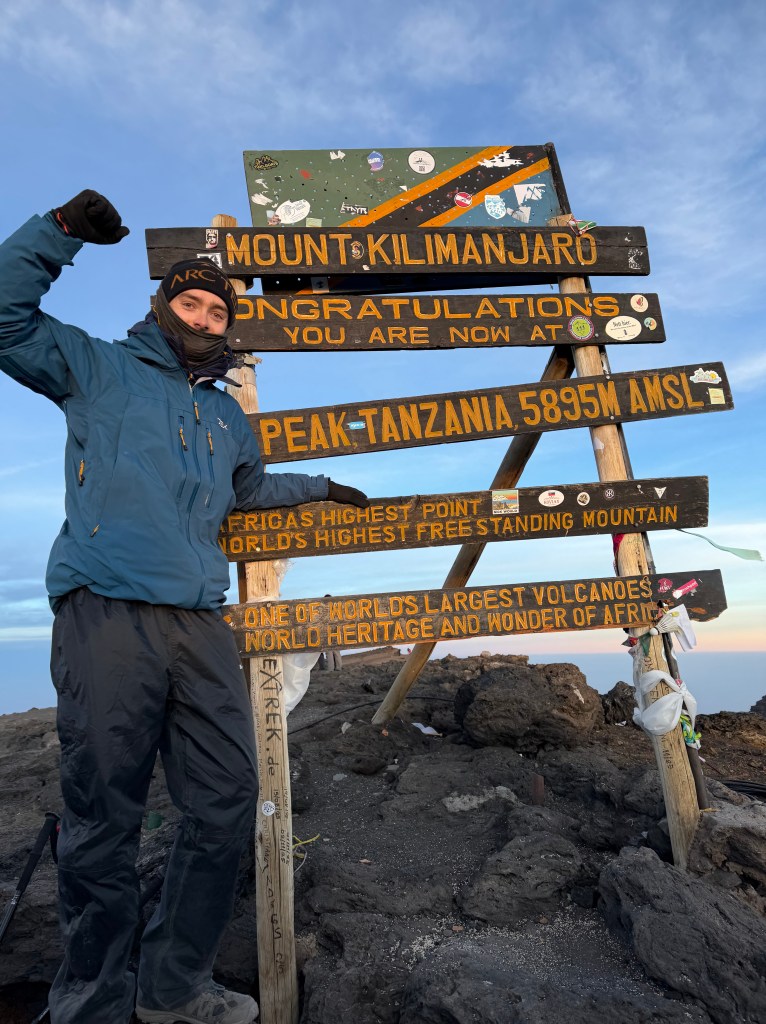
My memory of those precious minutes at the summit is as nebulous as my recollection of the hour before them. Due to the fatigue, the altitude, and the emotion, I struggled to make sense of the moment, and what I do remember is very difficult to capture in words alone.
By then, the sun had banished the night, and the sky was a flawless blue, save for a lingering tint of amber behind Mawenzi’s serrated peak in the east. Just beneath the crater, clouds stretched for as far as the eye could see, concealing the vast plains of Africa directly below.
Everywhere I looked, climbers dropped to their knees, raising their arms in victory. I turned and hugged Bakari, William, and as many of the porters as I could pull towards me, and plenty of my groupmates were then subject to the very same treatment.
Once the first round of hugging was complete, the obligatory photo shoot began. I made sure to get as many photographs as possible with the guides, and then waited patiently in line for my christening under the Uhuru Peak sign. Augustine quickly took a picture of me with my arms aloft, a triumphant image that successfully masks how utterly empty I felt. I then gathered with my team as we quickly captured a shared moment together at Africa’s highest point.
I stepped down wearily from the sign. The altitude, the bitter cold, and the sleepless night had taken their toll, and I knew I could not afford to stay at the top for much longer.
It must be said that the summit itself was not entirely idyllic. I was never far from the rumbling of guides from different tour companies arguing over whose group would be photographed next. Away from the squabbling, climbers were scattered around making no attempt to hide the fact that their stomach was no longer intact.
I was overwhelmed, I was hurting, and I was emptier than I ever thought possible. Yet none of that mattered. Nothing could diminish the sublime of the summit.
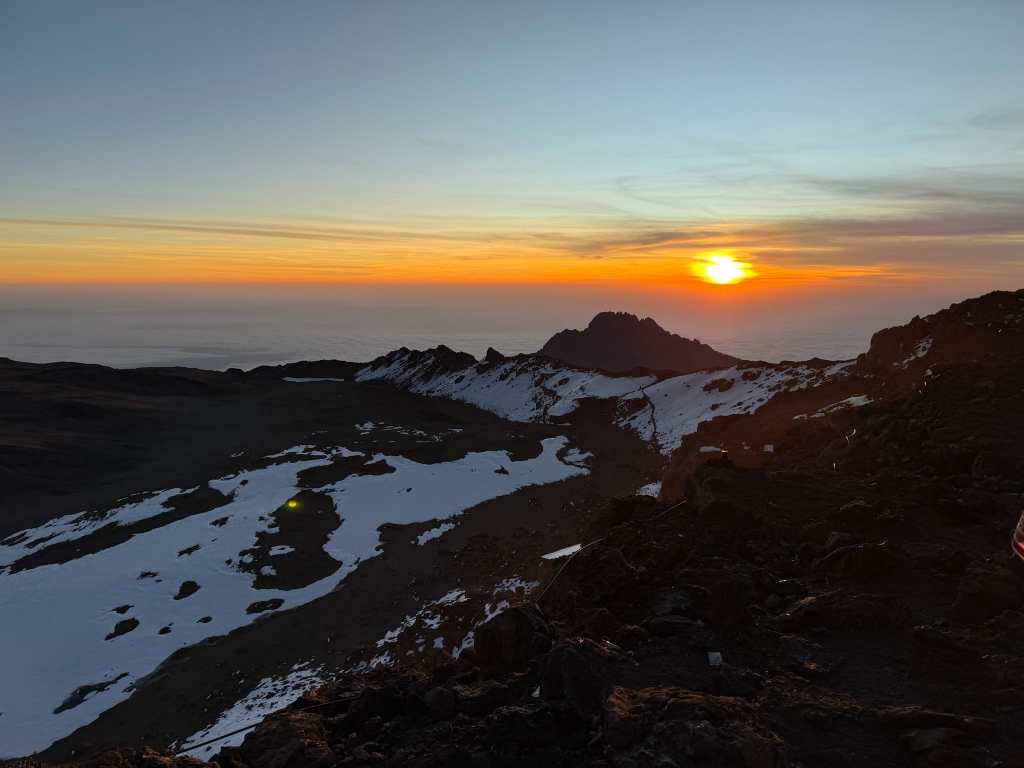
I’m not sure how long I was at Uhuru Peak, but I estimate it was no more than fifteen minutes. It was Augustine, in the end, who whisked me away to begin the descent back to Barafu Camp. I had dreamt of my moment at Kilimanjaro’s summit for months. I had spent the last six days fighting to make it a reality, and in the last eight hours I had expended everything I had to see it through.
However, I felt no urge to cling to a moment that is now a memory. The summit was magical, an instant in time I will cherish forever. But I was done. I needed to rest, and I was crying out for oxygen-rich air.
What’s more, I knew that another twist was still to come. When doing my research into the climb before the trip, most articles finished at the summit, leaving considerable uncertainty about what awaited us on the descent. Through the limited information I could find, it became clear that a new foe awaited on the descent: dust.
We returned to Stella Point, but instead of climbing down the way we came, the guides led us down a slope of loose scree. The gravel was so fine that a dusty plume kicked up with every step, and I coughed and spluttered as the gritty powder infiltrated my lungs.
There was also the challenge of trying to keep my balance, or should I say my apparent inability to do so. By now, my legs were wailing with every step, and my boots felt like they were doing nothing to support my blistered feet. My knees were taking a battering, made worse by the impossible task of finding stable ground to stand upon. Every other step, the ground fell away beneath me, and I found myself clinging to my poles for balance.
The taller and larger the climber, the more significant the struggle on the descent. As I stumbled, tripped, and fell from the summit, I watched on as my smaller counterparts floated elegantly downwards, vanishing into the distance. If they were snow leopards descending with grace, I was an oversized panda rolling uncontrollably with a complete absence of agility.
Such was the variation in our descending pace that the group was now scattered across the mountain. The slowest and most fatigued of us had the help of the porters, and whilst I spent almost as much time on my hands as on my feet, there were plenty of other climbers who laboured even further behind than me.
At one point I found myself alone on the mountain. The climb during the night had been the most isolated I had ever felt; a mental examination where I was accompanied only by the thoughts swirling sporadically through my head. Even then, as alone as I’d felt, the porters were no more than an arm’s length away, doing everything they could to push me towards the peak.
On the descent, however, there was not another soul in sight.
Until then, whether it was in camp, or along the trail, someone else had always been mere metres away. Even in the tent at night, my campmate and I were separated only by the gear clumsily mounted in the centre of the tent. On a mountain so vast, so boundless, I was surprised at how unusual descending solo suddenly felt.
The week walking in the wild, striding from rainforest humidity to glacial freeze, had been the greatest of my life. Unplugged from the digital world, I’d returned to a more authentic form of life. Nevertheless, as I cascaded down the scree-slope under the beaming African sun, I longed to call home and share my story with those waiting for me from afar.
After an hour and a half of descending, and countless falls along the way, Barafu Camp eventually inched into view. I was met by four porters who came to support me through the final moments of the return trip from the summit. Or maybe they’d caught word of the battered Brit bumbling his way down the mountain, and had hurried to pick up the pieces.
Whatever the reason, the porters treated me as if it were my coronation. They chanted in Swahili and cheered my name, giving me a hero’s welcome as I meandered my way through an assemblage of scattered boulders. It was a hero’s welcome they were far more worthy of than I.
A similar welcome awaited me when I finally crawled into camp. I was cheered home, slapped on the back, and quickly rushed into a chair. A cold drink was thrust into my hand, and Michael radioed up the mountain to let the remaining guides know I had returned to camp. I had no idea how many had returned safely already, and who was still descending.
The porters continued to make a fuss over me, bringing refreshments and warm water to wash my swollen feet. I pleaded that they had already done far too much, but my words fell on deaf ears. They were intent on doing everything in their power to make my journey as easy as possible, and it was clear their care would not stop until I stepped beyond the boundaries of the Kilimanjaro National Park.
I sat slumped in the chair for quite some time. Radios buzzed around me, with porters calling in to inform the whereabouts of various climbers still scattered down the descent. Slowly, I untied my shoelaces, spluttering as my boots coughed up a thick cloud of dust. I pulled off both layers of thermal socks just as a timely breeze swept across the ridge. The cool air felt serene; at long last my feet could breathe.
I wiggled my toes, and as I did so I felt the beginnings of cramp shoot through the soles of my feet. They had taken quite some punishment; I’d lost all feeling in them in the chill of night, but now they were overheating after hours wrapped in a double layer of insulated socks. The thought of sitting motionless in my chair, resting my feet and watching as the day passed by, was a tantalisingly tranquil prospect.
Alas, that little dream would have to wait a little while longer. Whilst Frodo and Sam were saved by the eagles on Mount Doom, no such mythical creature would come to my aid. It would once again be down to the mythical strength of the porters to get me down in one piece.
So, after an hour slumped in the deck chair, I hauled myself clumsily to my feet. I glanced once more up at the white gleam of Uhuru Peak, smiling in the knowledge that I had been fortunate enough to stand upon the summit. I put my left foot forward, and winced as every fibre in my legs pleaded that they could go no further. But the four hour hike to Mweka Camp could not wait any longer, and I begrudgingly began the descent.
Strangely, the blaring alarm from my muscles and joints soon faded to little more than a distant murmur. Perhaps I was so fatigued that any additional exertion was negligible, or perhaps the prospect of a return to a lower altitude was luring me down the mountain. Either way, I was pleasantly surprised to find myself capable of putting one foot in front of the other. It was hardly the sight of raw athletic supremacy, but I was content nonetheless.
During the ascent of Kilimanjaro, the ponderous speed allowed me to observe the changing geography step by step. For six days, the Machame Route had wound slowly around the mountain, teetering for days between 3,500 and 4,500 metres. Hour after hour, I had watched the landscape change from green to grey, moving slowly from one far away land to the next.
However, if the ascent was a twisting mountain road, the descent was more akin to a German Autobahn.
From Barafu Camp, the path drops immediately down, stretching 7 km directly to Mweka Camp. It quickly became clear why the trail is used for descending only; it took nearly a week to rise from the rainforest to the Arctic summit zone, but within two hours of descending the dust had vanished and we were heading towards a sea of deep green.
Whilst the upper zones of Kilimanjaro had been an extraterrestrial experience, the return of vegetation was a welcome sight. The dust and rocks which I had become so accustomed to were replaced by slippery networks of entwined roots, snaking along the narrow trail. The further we descended, the thicker the roots grew, protruding from the East African camphorwood and wild fig trees rising 25 metres high in the canopy above. On Augustine’s instructions, I kept my eyes peeled for the sudden movement of colobus monkeys swinging freely, or a two-horned chameleon perching on a nearby branch.
As I descended, I realised that my headache had all but disappeared, and my heart rate had lowered dramatically too. I gulped in the nourishing air, eager to deliver a healthy supply of oxygenated blood to my muscles and organs. I knew I would be back in London by the time my legs recovered, but my mind was already starting to clear. It was as if a packed cloud of fog had suddenly been lifted, unshackling my thoughts to move freely inside my head once again.
Eventually, we arrived at Mweka Camp, returning to the upper edge of the montane rainforest. Giant heathers sprang from the earth, their slender branches weaving together to create a twisting vine of shade for the tents. Thin rays of sunlight crept through chinks in the canopy’s armour, catching pale green strands of ‘Old Man’s Beard’ lichen drooping loosely from the lower branches.
Long before crowds of climbers wandered through the cloud forest, Chagga communities had cultivated the slopes around Mweka (Tanzania’s third-largest ethnic group) for generations. To the Chagga communities, Mount Kilimanjaro is a sacred entity, and its glacial runoff is perceived as deeply connected to the spirits of their forebears. For centuries, the freshwater encompassing this region was the lifeblood of the communities nestled below, sustaining their families, livestock, and kihamba – the traditional banana and coffee forest gardens.
Yet the water didn’t trickle naturally to their needs, and it was the local community who redirected its flow. Using only gravity and the strength of their bare hands, the Chagga people carved a 1,800 kilometre network of channels (known as mifongo) to redirect glacial meltwater and mountain streams down through the forest to irrigate their crops.
It may appear that the Chagga communities and Kilimanjaro lived in a perfect harmony of nature and man. However, this was not always the case, and during the 18th and 19th centuries, the area was the battleground of merciless tribal conflicts.
In the dry seasons, the Maasai would raid the Chagga slopes, targeting their water source and cattle. Whilst the local communities were outnumbered and outpowered, you could not say with certainty that they were out-skilled. Just as they had chiselled irrigation channels into the mountainside, the communities used their hands to find a means to survive once more. Desperate to elude the Maasai, the Chagga people dug huge underground tunnels (now known as Chagga Caves) deep into the volcanic rock, creating an emergency shelter. Sensing an oncoming raid or tribal conflict, Chagga families and their livestock would vanish into the secret chambers for weeks at a time.
Most would imagine this meant cruel weeks in endless darkness, bound by hunger and mere drops of water to drink. Yet that was not always the case. Such was the craftsmanship of the Chagga communities, they often built hidden ventilation shafts and secret channels to divert the underground springs into their caves, providing an essential supply of water and oxygen.
As Bakari registered the team in the ranger’s hut, I drooped wearily on a small patch of grass outside. After 18 hours on my feet, I was at my limit. The descent had taken its toll on my knees, and they were now just as depleted as my calves had been at the summit. The humidity was oppressive, and when I removed my hat it was as if I’d breached a dam. Thick beads of sweat trickled down my cheeks, and I felt the damp ends of my matted hair dangling against the back of my neck. I knew that a layer of dirt and gunge had accumulated on the surface of my skin, and when I pulled off my socks I saw several blisters bubbling on my heel. I had never been so utterly incapacitated, nor so ashamed of my personal squalor.
And yet I felt serene.
I closed my eyes, and allowed the warm glow of the sun to beam down upon me. Yes, I yearned for the luxuries of home: a warm shower, a soft bed, the first sip of a freshly poured beer. But did I truly want to leave my dusty, volcanic home? Was I really ready to say goodbye to the mountain I had dreamt of, or the people who had brought it to life? Of that, I wasn’t so sure.
Clinging to my final hours on Kilimanjaro, I spent the evening talking with January inside the communal tent. I had grown very fond of him, and knew that I would find it difficult to say goodbye. He had been the first to congratulate me on my return from Uhuru Peak, just as he had been there with words of encouragement as I took my first steps to the summit the night before. Without January’s meticulous preparation at every meal, the challenge might have been impossible altogether.
Over a cup of warm milk, we asked each other about our lives away from the mountain. I learnt that January was one of twelve children, and that he himself had a child awaiting his return. When he discovered that I, at the grand age of 22, was both wifeless and childless, he burst into a bewildered laugh.
He took some convincing, but upon realising that I was not joking, January reasoned that I should return to Tanzania for his wedding in 2027. There, he assured me, I would be able to address my glaring failure.
As night crept in, January and I were joined by the rest of the team for our last dinner in the communal tent. We celebrated our victory over a final portion of chicken and rice, before another cake was mysteriously conjured up from the depths of the rainforest. We shared memories, and the thoughts that had helped us rise to the summit. The conversation then turned to what we were each most looking forward to when we stepped through Mweka Gate, in less than twenty-four hours’ time.
The crowning jewel of the trip had flashed by; for months each of us had clung to the possibility of standing atop Africa’s highest peak. Twenty-four hours earlier, we had sat huddled together on the ridge of Barafu Camp, clinging to our chairs as the wailing wind mauled the thin lining of the tent.
A small voice in each of our heads had whispered that the night ahead was a step too far, a shining peak just out of our reach. However, after reading the promised yellow letters of the Uhuru Peak sign with our very own eyes, those same voices had grown awfully quiet.
The summit of Kilimanjaro had been the destination of my dreams. Now it was a page in my history, and one I will have marked for eternity.
Day Seven (9 km): Mweka Camp (3,080 metres) – Mweka Gate (1,680 metres)
“The world is not in your books and maps. It is out there.” – Gandalf the Grey, The Hobbit: An Unexpected Journey
At 6:30 am, an alarm rang.
Bleary-eyed, I lay disoriented, trying to piece together where I was. A tent, of that I could be sure. But where?
I fumbled around for something, a headtorch perhaps. I found one by my head, only to recoil as I beamed the flash directly into my eyes. Who was that rustling outside?
After recovering from the blinding light, I noticed that I hadn’t entirely made it into my sleeping bag the night before. Only one of my legs was covered, and both a portable charger and a book lay on my chest. Looking down, deep sleep marks were imprinted along my forearm, and the fingers of my right hand were still curled around my phone. Clearly, sleep had hit me before the bedtime procedure had been completed. Or started, for that matter.
My head snapped to the right, and I watched as a strangers hand unzipped my tent. Was I still dreaming?
“Breakfast,” came a cheery voice from outside. I unzipped the inner lining of the tent, and poked my head outside. My eyes were still adjusting, but when I looked up I saw the warm, smiling face of January looking down at me.
His appearance reminded me of my whereabouts. I was on Mount Kilimanjaro, in the north-east of Tanzania. It’s roughly 200 miles south of the Equator, and the tallest-free standing mountain in the world.
And twenty-four hours earlier, I’d stood upon it’s summit.
With my recollection returning, and my ego growing with it, I rolled clumsily out of the tent onto the damp dew of a misty African morning. I looked to the sky with a grin on my face. I felt like I was hungover, only without the headache, or the nausea, or any looming feeling of dread.
Still assembling my fragmented memory back together, I was yet to piece together whether I’d been asleep for hours or days. Was anything I remembered actually real?
For six straight days, I’d hurriedly gulped down my breakfast and pulled on my walking boots ahead of an early start on the trail. Generously, that urgency subsided on the seventh and final day on the mountain. There would be no rush to devour every carbohydrate in sight, nor a nervous wait for the portaloo.
Throughout camp, a tranquil atmosphere of quietude and rumination floated between the tents. The suspense of the proceeding days was no more, and the creeping whispers of doubts I’d listened to each day faded into a vague memory.
William poked his head through the tent doors, and we prepared for the routine examination of our vitals. Blood oxygen? Heart rate? Bowels movements? Medicine taken? I knew the drill by then.
Only, William was grinning. It took me a moment to realise that he was empty handed; there was no finger tip reader, no documents, not even a questionnaire. The threat of thinning air had departed, and the absence of the blood oxygen test only added to the enveloping sense of calm.
Ludicrously, I knew I would miss even the most anomalous of Kilimanjaro’s daily customs. I wondered when I’d next sit shivering in a tent, huddled around strangers as a mountaineer quizzed me on the consistency of my bowel movements. I wondered too when I’d next use baby wipes to hopelessly claw away at the dirt underneath my nails, or sip ginger tea to relieve nausea on a bare mountain ridge. It’s strange how quickly such idiosyncratic behaviours start to feel like home.
Following a leisurely first hour of the day, we began the final 9 km trudge towards Mweka Gate. A return to society was imminent, and the gate itself loomed like a portal that would return us to the shining screens of the digital world, away from the primitive routine of the mountain I’d become so accustomed to.
As I ambled down the narrow forest path, I made a conscious effort to spend as much time as possible with Augustine, our lead guide for the final day. Twisting our way through the lush green of the montane rainforest, Augustine assured me that we would not set foot beyond the national park without sighting a black and white colobus monkey. On a bucket list trip already overflowing with moments I’ll cherish, spotting this particular monkey was the last missing piece.
I kept my eyes peeled, and it was not long before the rustle of a swinging primate echoed from the canopy above. Every ten metres, I scanned the endless network of branches, as if to will the monkey into view. All around me, climbers stopped and peered upwards. I quickly realised that the swaying of branches was not coming from one direction, but several. How many were there?
As the rustling went on, we crept to an opening where the trees parted to offer a view of Kilimanjaro’s glistening peak. Yet for once, my attention was elsewhere. Augustine placed his hand on my shoulder, and using his index finger, he diverted my gaze to the upper branches of an East African camphorwood, some 40 metres overhead.
The tufted white fur sprouting from a surface of matt-black beneath was unmistakable: a single Mount Kilimanjaro guereza, feasting upon the fresh leaves of the very tree it was perched upon. A branch swayed to the side, and suddenly another monkey swung into view, joining its companion on the branch. And then another!
Three beautiful, luxuriously coated monkeys, nestled together upon a branch, with Uhuru Peak rising in the background. It was like a picture pulled straight from a National Geographic magazine.
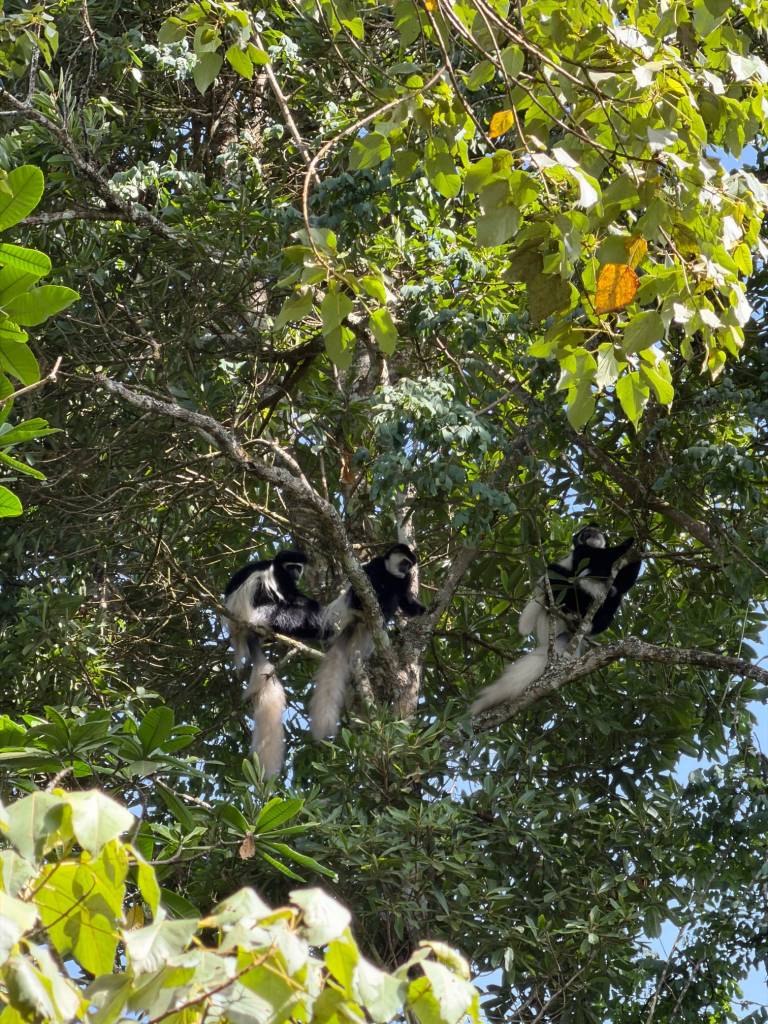
Black-and-white colobus monkeys are found in forests across West, Central and East Africa. However, the International Union for Conservation of Nature actually recognises the population living on Kilimanjaro, and neighbouring Mount Meru, as a distinct species: the Mount Kilimanjaro guereza (colobus caudatus).
Whilst their close relatives inhabit warm, tropical forests, the Kilimanjaro guereza are adapted to life in the high mountains. Most visible of these adaptations are the thick patches of white fur, which are far more prominent on the Kilimanjaro guereza when compared with their cousins. While black fur absorbs the sunlight efficiently during the daytime sun, their long flowing white hairs act as a heavy thermal blanket when they curl up on a cold branch at night.
During periods of localised rainfall and deep fog, their white mantle hair creates a coarse outer thatch; rain droplets roll off their snow-white cape, rather than soaking into the black undercoat. This keeps the monkey’s skin dry, and limits their exposure to hypothermia in the long rain season from March to May.
The word ‘colobus’ is drawn from the Greek word ‘kolobos,’ which can be translated as ‘mutilated’ or ‘maimed.’ Strikingly, this is because they are one of the only primates on planet Earth without a functioning thumb. However, the translation of ‘maimed’ is misleading, as the Kilimanjaro guereza is actually an astonishing example of a successful evolutionary adaptation. Their hands have evolved to function as four-fingered hooks, allowing them to expertly swing through the trees, gliding effortlessly from branch to branch across the top of the forest canopy.
In 2019, the IUCN estimated that there were still over 10,000 swinging freely on the slopes of Kilimanjaro and Meru in Tanzania, and whilst they are still vulnerable to climate-induced habitat changes, the national parks of Kilimanjaro and Arusha have kept their decline largely stable. The same cannot be said, however, for the dwindling few that still linger across the border in Kenya. There, its believe that just 200 remain; a number that has earnt the Kilimanjaro guereza the title of Kenya’s most threatened primate species.
In Kenya, the entire population of Kilimanjaro guereza can be found exclusively in two habitats in the south of the country: the Loitokitok Forest Reserve, and the Kitobo Forest Reserve. The monkeys do not range further north because they depend on the climate and moisture systems created by Kilimanjaro. The springs feeding Kitobo Forest, for example, can be traced directly back to Kilimanjaro’s springs.
Surrounding these two reserves lies the desolate Acacia bushland. The distance across the open savannas to the next safe canopy stretches as far as 20 miles of flat, deforested land. Crossing a mere hundred metres on the open ground leaves the Kilimanjaro guereza exposed to predators, vehicles, and even starvation, and they are thus marooned on these lonely forest islands.
Despite their vulnerability away from the slopes of Kilimanjaro, the monkeys were hardly elusive as I curved my way down the rooted path. Every few steps, a conversation was interrupted by a swishing sound from the canopy, and a darting flash of black and white swung gracefully from branch to branch.
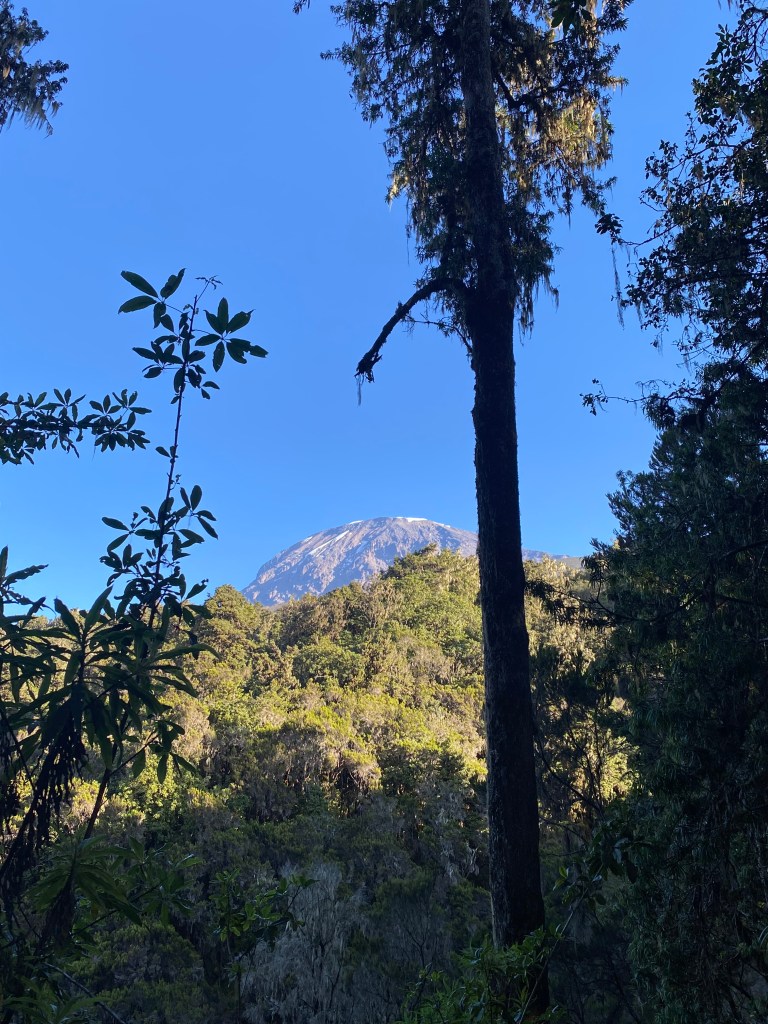
The white gleam of Uhuru Peak persisted through a gap in the trees to my right. It felt peculiar to be walking away from the summit, rather than struggling towards it. I thought of the many climbers who, like me, looked back towards the eminent peak of Kibo, wondering if they would ever return to the roof of Africa.
I mused over what they’d felt in the days that followed. Was it satisfaction at a vision vindicated? Or a craving for more?
Elated as I was, I knew this feeling would not go on forever. Many find that the euphoria that comes after conquering a summit is followed by a yearning for the next horizon. Satisfaction itself is an elusive enigma, and whether it is a literal peak or a figurative mountain top, completion is only ever fleeting. For many, attention is soon diverted to what’s next.
In his memoir documenting his horrific fall and miraculous survival on Siula Grande in 1985, Joe Simpson touches upon this paradox. Upon cresting the summit in the Peruvian Andes, Simpson writes:
“I felt the usual anti-climax. What now? It was a vicious circle. If you succeed with one dream, you come back to square one and it’s not long before you’re conjuring up another, slightly harder, a bit more ambitious – a bit more dangerous.”
Simpson’s dichotomy is an affliction shared by many who feel the pull of adventure. While a journey may end with a safe return home, the conclusion rarely closes the chapter entirely. A new dawn eventually breaks, but only after the dreams of deep sleep have taken hold.
These visions are fanciful at first; a step too far, a manifestation of insatiable greed for the wild. Yet, they quickly gather momentum, tumbling through the mind until we realise our waking hours are spent clinging to their fiction.
During the commute to work, or over dinner with a loved one, a vacant stare insinuates. The ordinary becomes unsavoury, and try as we might, the soul struggles to reconcile itself to what now feels tediously mundane. Soon, the wilderness’ promise to liberate us from the enervating placidity of Western life becomes too great to neglect. We cannot ignore its call. We mustn’t disregard its allure.
The question, then, is why? Why are some of us so susceptible to this great lure of the mountains? Why does their mystique take such a hold over our imagination?
I cannot answer for everyone, and I’m certain that the subtleties of the answer differ from person to person. What I do know is this: since my childhood, I have been at my happiest in the mountains. Whether the ‘mountains’ were simply the rolling hills of the Peak District, the craggy peaks of Snowdonia, or the giants of the Alps, the size of the mountain was never truly important. Regardless of their magnitude, the mountains have always evoked a sense of clarity over me, a place where the internal voices dimmed, and the tightness of everyday stressors unwound.
Kilimanjaro was far beyond anything I had attempted before. But even as I walked through the rainforest to Mweka Gate, I knew that it had lit a fire inside me for more. Not just to climb mountains, but to seek new experiences and cultures, and for circumstances I previously felt were reserved for the people I watched on my screens.
The truth is, anyone, in any walk of life, has the capacity to experience wonder. Adventure is perhaps the most obvious channel to do so, but the discomfort that comes with adventure is often what creates the magic, and this feeling can be recreated elsewhere.
For every moment of splendour it provided, Kilimanjaro was viscerally uncomfortable from start to finish. The obvious examples are the freeze and relentless headache of summit night, as well as the primitive pleasantries that come with living inside a tent. But travelling alone, to a continent so far away from home, and walking side by side with people from a culture so different to my own, were equally unnerving. Yet this experience provided me with lessons in living I could not have found through the convenience of life at home.
I am confident that it will not be the last time I set foot on Kilimanjaro. I feel that I will return one day, not only for the climb, but to learn more about the land away from the gleam of its finest jewel. With that in mind, I decided that it was a good thing that I hadn’t been to the Serengeti or the Ngorongoro Crater, as this leaves me with no choice but to return in the future.
Eventually, the wooden triangle of Mweka Gate came into view. Empty minibuses trundled beneath its arch to collect the weary climbers whose week long adventure was now at an end. We were at the very edge of the montane rainforest, and the road ahead led back to Moshi, and back to civilisation itself. The surrounding trees maintained the high canopy, but as I peered into the distance I saw that the smooth tarmac wove through a rural countryside of coffee farms and banana plantations.
I hurried into a small shop to my left to buy a can of Coke. A blistering heat had ensued, and I gulped my sugary refreshment down in an instant. First Western convenience, check.
Without a moment’s rest, William walked into the office station to register the safe return of his team and clients. Ten minutes later, he returned with my official certificate confirming my successful summit of Mount Kilimanjaro. At last, the prison-cell-like décor of my bedroom would have a new ornament to behold.
The porters hurried over to a group of minibuses, and began to load our home for the past week on board. I found a small patch of grass outside the registration centre, and I toppled in a heap on the soft ground. I lay there, staring up at the blue sky, clinging to the final pages of a story that I didn’t want to end.
I pulled out my phone, which had remained in aeroplane mode throughout the week to preserve its charge. My finger hovered over the button. I hesitated. The gate was less than twenty metres away, but a small orange button on my screen was the true final page of the adventure. The moment I pressed it, I would plug myself back into the digital universe.
I checked the time. 10:25 am. ‘That’s 07:25 back home,’ I remember thinking. My family would be waking up to start their weekend, and I couldn’t wait to share a snippet of my journey with them. Yet, that meant clicking the ominous orange button on the top left of my screen. I decided to hold off a little while longer.
I was interrupted by Bakari, addressing the group as a whole. We would be leaving in twenty minutes, as soon as the porters had loaded the vans and completed their final checks. We would drive into the bustling town of Moshi, to collect some souvenirs at a local gift shop, before heading back to the Weru Weru River Lodge. There, we’d hold a final ceremony and each tip $400 to the crew, who would then sing us a final song as we thanked them one last time for bringing our dreams to life.
The obligatory $400 tip may sound like a hefty price for a trip that already cost £2,000, without taking into consideration the cost of flights and the essential gear required for the journey. The truth is, the tip could not possibly scratch the surface of what they deserved, nor adequately reflect what they meant to me.
Under the absolute highest ethical guidelines set out by the Kilimanjaro Porters Assistance Project (KPAP), our 28 member support crew required just $2,590 in total tips (from each climber: $35 per day for the lead guide, $25 per day for assistant guides, $20 per day for chefs, and $10 per day for porters). For our group of nine climbers on a seven day trek, our total tip pool of $3,600 far exceeded the upper limit of these guidelines.
However, to put this into context, an adult working a single eight-hour shift on the London Living Wage receives £123.60 per day (roughly $164). Even at these premium mountain rates, a porter’s entire week of backbreaking labour yields a maximum of $70, less than half of what a London worker makes in a single day.
To say this is unfair would be an understatement, regardless of the vastly different circumstances of my comparison above. Despite the glaring injustice, the value, skills, and captivating humanity of the porters and guides cannot, and should not, be limited to a numerical figure alone.
Something I felt as early as the first night was solidified beyond doubt throughout my week on Kilimanjaro: the mountain embodies the beauty of our natural world, but it is the porters who give its majesty a heartbeat. Their tireless work, endearing friendship, and endless wisdom are what made my experience so special, both in the moments of awe and the times of doubt.
I implore anyone who climbs Kilimanjaro to tell the story of the porters to anyone who will listen, and especially to those who won’t. Become the annoying friend who speaks endlessly of what they gave to you, who still rambles on long after the journey has ended. Research where you can support, and get in touch with the charities that work to improve their quality of life. There is no doubt in my mind that they deserve incalculably more than what I could offer through a handful of crumpled bank notes.
After sharing the details of the hours ahead, Bakari walked away to join his fellow porters and guides loading the bags into the minibus. I rolled onto my back Scratching the hair on the back of my neck, I thought longingly of the shower and shave that awaited me at the lodge. I wondered too if there was a place to wash my clothes; I already dreaded the raised eyebrows and flared nostrils of whoever was unfortunate enough to sit next to me on the plane home. Qatar Airways has yet to offer an upgrade that guarantees you won’t be seated next to a hiker desperately lacking in clean clothes. I didn’t want to be the reason that option became necessary.
It felt wrong to be thinking of the flight home without having stepped outside the Kilimanjaro National Park. Yet, in less than twenty four hours time I would sit on the runway at Kilimanjaro International Airport, and begin a day of travel to Dar es Salaam, Doha, and finally London Gatwick. In less than forty eight hours time, I’d open my laptop and stare at the dreaded purple logo of Microsoft Teams. The same shade of purple the sky had shone around Uhuru Peak on my first morning on the mountain.
I sighed, and accepted that my journey was at an end. But the story would live on for eternity in my mind, and I knew the memories would soon plant the seeds of my next adventure.
With that comforting thought, I pressed the button at the top left of my phone and opened WhatsApp to call home. It was time to tell my family the story of my week climbing Mount Kilimanjaro.


Leave a Reply